Market NewsBeginner7 min
What is a crypto liquidation, and why can prices drop so fast?
Bitcoin fell below $70,000 overnight and more than $1 billion of leveraged bets were closed by force. Here is what a liquidation is, why forced selling can make prices fall faster, and why you can't be liquidated if you hold crypto without borrowing.
By Rumos · 2 min. ago

In this article
On Friday morning, 13 November, Bitcoin was trading at about $68,800, down roughly 6.5% in 24 hours, according to CoinGecko. Several news outlets called it the lowest level since August. Ether slipped below $2,000, and the value of the whole crypto market fell about 7% to roughly $2.3 trillion. Moves like this usually come with one word in the headlines: liquidations. Here is what that word means, why it can make prices fall faster, and what it means for you.
Key points: what is a crypto liquidation?
- Bitcoin fell below $70,000 overnight and was about $68,800 on Friday morning, down roughly 6.5% in 24 hours, according to CoinGecko.
- More than $1 billion of leveraged crypto bets were closed by force in a day, and the large majority were bets on prices rising, according to CoinGlass data.
- A liquidation happens when someone trades with borrowed money and the price moves far enough against them that the exchange closes the trade automatically.
- Forced sales can push the price lower and set off more forced sales, which is one reason crypto can drop fast.
- If you hold crypto without borrowing, you cannot be liquidated. Your holdings fall in value, but nothing is sold for you.
What happened in crypto overnight?
According to liquidation data from CoinGlass, more than $1 billion of leveraged positions across crypto were closed by force within 24 hours. In Bitcoin alone, about $870 million of bets on rising prices were closed, against about $34 million of bets on falling prices. So roughly 96% of the Bitcoin positions closed this way were bets that the price would go up.
News reports pointed to several things at once: a stronger US dollar, worries that US interest rates could rise again after recent inflation data, a selloff in technology shares, and money flowing out of Bitcoin funds listed on US stock exchanges. No single cause explains the whole move. The reasons behind a fall are often clearer in hindsight than on the day.
What is a liquidation?
Some traders don't only buy crypto with their own money. They also borrow from the exchange to make a bigger bet. This is called trading with leverage. A trader who puts in $1,000 with 10x leverage controls a $10,000 position.
The trader's own money works as a safety deposit, called margin. If the price moves against the trade, the losses come out of that deposit first. When the deposit is almost used up, the exchange doesn't wait for the trader to decide. It closes the position automatically so that the borrowed money is protected. That automatic close is a liquidation, and the trader usually loses most or all of the deposit.
A bet that the price will rise is called a long, and a bet that it will fall is a short. When prices drop sharply, it is mostly longs that get liquidated, which is what happened this week. A liquidation is a feature of borrowing, not a sign that something is wrong with the coin itself.
How far can the price move before a position is liquidated?
The higher the leverage, the smaller the move it takes. As a rough rule, the price move that uses up the whole deposit is 100% divided by the leverage. Exchanges close positions a little before that point, because they keep a small safety buffer and charge fees.
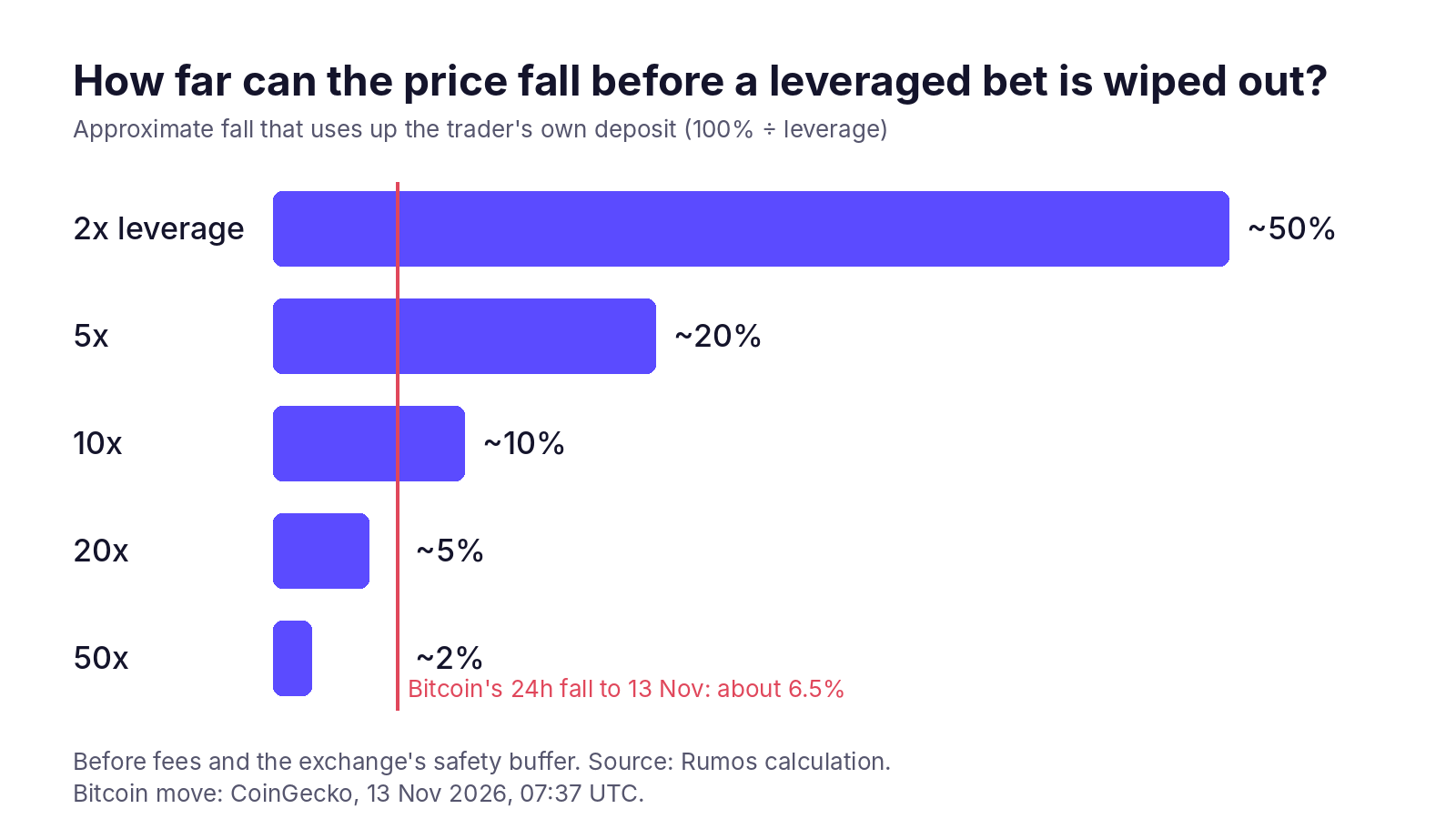
With 20x leverage, a 5% fall is enough. Bitcoin fell more than that overnight, which helps explain why so many positions were closed at once. Leverage makes losses grow just as fast as gains, and a whole deposit can be lost within hours.
Why do liquidations make prices fall faster?
When a long position is liquidated, the exchange sells the crypto straight away, at whatever price buyers are offering. Those sales push the price down a little further. The new, lower price can then reach the level where other leveraged traders get liquidated, which causes more automatic selling.
This chain reaction is called a liquidation cascade. It can turn an ordinary dip into a sharp drop within minutes, especially at night or at weekends, when fewer buyers are active. It also works the other way: when many short bets are closed by force, prices can jump quickly.
A cascade says little about the long-term value of a coin. It mostly shows how much borrowed money was in the market and where it was placed.
Does this affect you if you only hold crypto?
If you bought crypto with your own money and didn't borrow, you can't be liquidated. Nobody sells your coins for you. The value of your holdings goes down with the market, and it recovers only if the market does.
What does reach you is the price. Cascades can make drops deeper and faster than you might expect, so it helps to know they exist before the next one. Fast moves are a reason to check your own plan, not a signal to act in a hurry.
What to watch
- Liquidation totals: large daily totals show how much borrowed money is being pushed out of the market.
- Leverage in the market: data sites publish "open interest" and "funding rates", which show how much traders are borrowing and on which side.
- US economic data: inflation figures and US interest-rate decisions have been moving crypto along with other markets.
- Fund flows: money moving in or out of exchange-listed Bitcoin and Ether funds is reported every trading day.
What you can do now
- Check whether anything you use involves borrowing, such as margin or futures trading. If a product lets you choose a multiplier like "5x" or "10x", it uses leverage.
- Decide in advance how big a fall you could live with, and only put into crypto money you can afford to lose.
- Learn how risk and costs work in investment basics, or join a live session on our workshops page.
- Read more beginner explainers in our news section.
Questions readers ask
What does it mean when crypto is "liquidated"?
It means an exchange closed a trader's leveraged position automatically, because the price moved so far against it that the trader's own deposit could no longer cover the losses.
Can my crypto be liquidated if I don't use leverage?
No. Only positions that use borrowed money can be liquidated. If you own your crypto outright, its value can fall, but it isn't sold for you.
Why were most of the liquidations "longs"?
Longs are bets that the price will rise. When the price falls sharply, those are the positions losing money, so they are the ones exchanges close.
What is a liquidation cascade?
It is a chain reaction: forced sales push the price lower, the lower price sets off more forced sales, and so on. It can make a drop much faster than usual.
Does a big liquidation day mean prices will keep falling?
Not necessarily, and nobody can reliably say where prices go next. A liquidation day shows that a lot of borrowed money left the market, not which way the market moves after it.
Crypto prices can rise and fall sharply, and you could lose some or all of the money you put in. Crypto is not covered by deposit protection. This article is for education, not financial advice.