Simple vs Compound Interest
A quick guess

By the end you can tell simple from compound interest and work out a compounded balance.
Two savers each put away €1,000 (or $1,000) at 5% a year and leave it for 30 years. Example only.
- Saver A earns interest only on the original 1,000, so after 30 years A has 2,500.
- Saver B earns interest on the 1,000 and on the interest already added.
Same rate, same start, same time. The only difference is whether interest earns interest. That difference has a name: compound interest.
Before you read on, commit to a guess in the next question: how much does Saver B have after 30 years?
Quick check
Compound interest, a first guess: Saver A puts 1,000 at 5% a year, earns interest only on the original sum and has 2,500 after 30 years. Saver B gets the same 5%, but also earns interest on the interest already added. About how much does B have after 30 years?
Simple interest
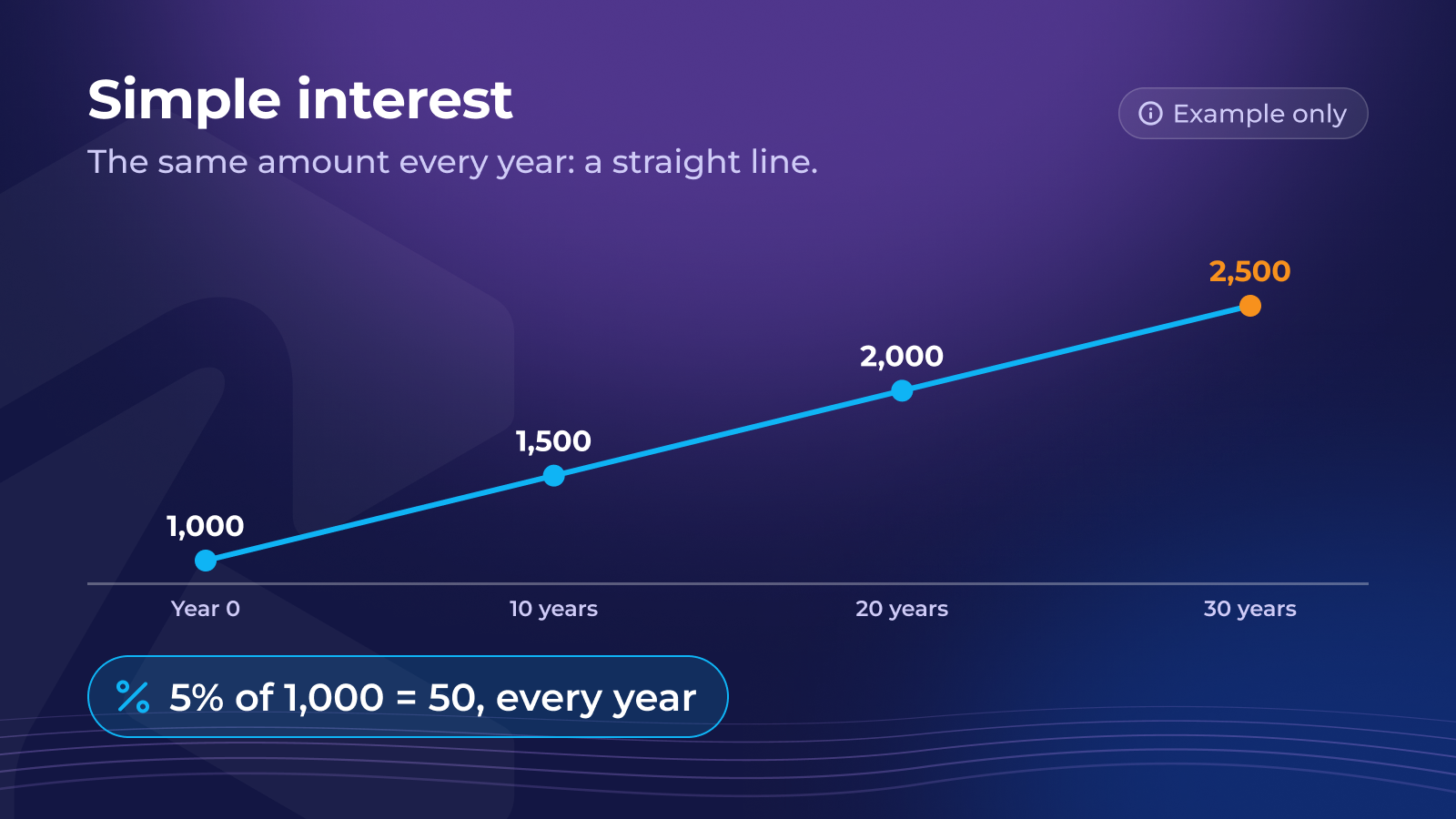
The answer: Saver B has about 4,322, against A's 2,500. Most people guess far lower. To see why, start with the straight line.
With simple interest, you earn the same amount every year, always calculated on the original sum.
1,000 at 5% earns 50 a year, every year:
- after 1 year: 1,050
- after 10 years: 1,500
- after 30 years: 2,500
On a chart that is a straight line: growth adds up at a steady pace. It is how most of us intuitively imagine growth. Keep that line in mind: the next step bends it.
Compound interest
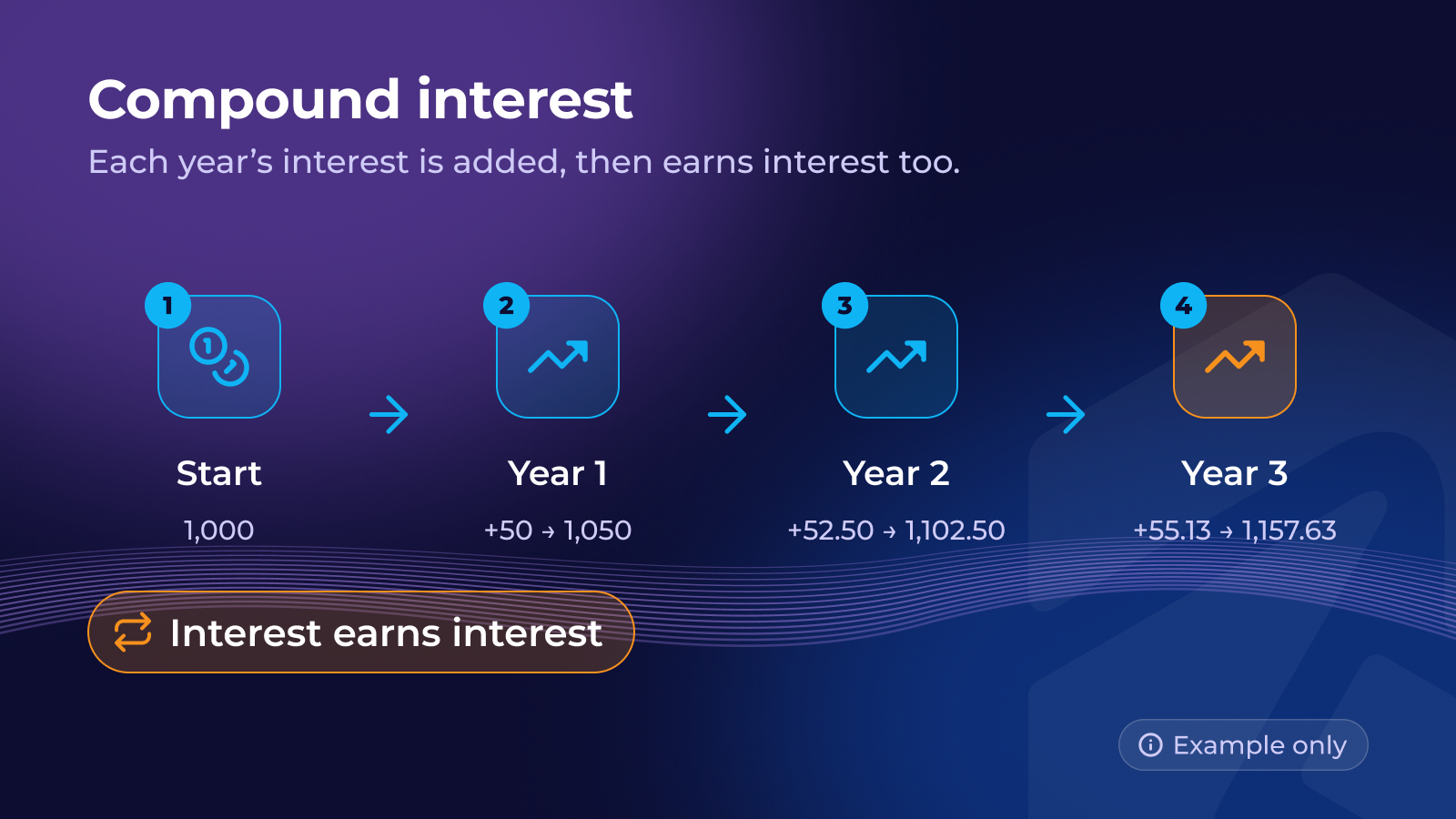
With compound interest, each year's interest is added to the balance, and next year's interest is calculated on the new, bigger balance.
- Year 1: 1,000 × 5% = 50 → 1,050
- Year 2: 1,050 × 5% = 52.50 → 1,102.50
- Year 3: 1,102.50 × 5% = 55.13 → 1,157.63
The extra each year is small at first: 2.50, then 5.13. But it keeps growing, because interest earns interest. The short formula is:
amount × (1 + rate) to the power of years, so 1,000 × 1.05 to the power of 30 ≈ 4,322.
Quick check
Compound interest: 1,000 earns 10% a year, compounded once a year. How much is there after two years?
Why we underestimate it
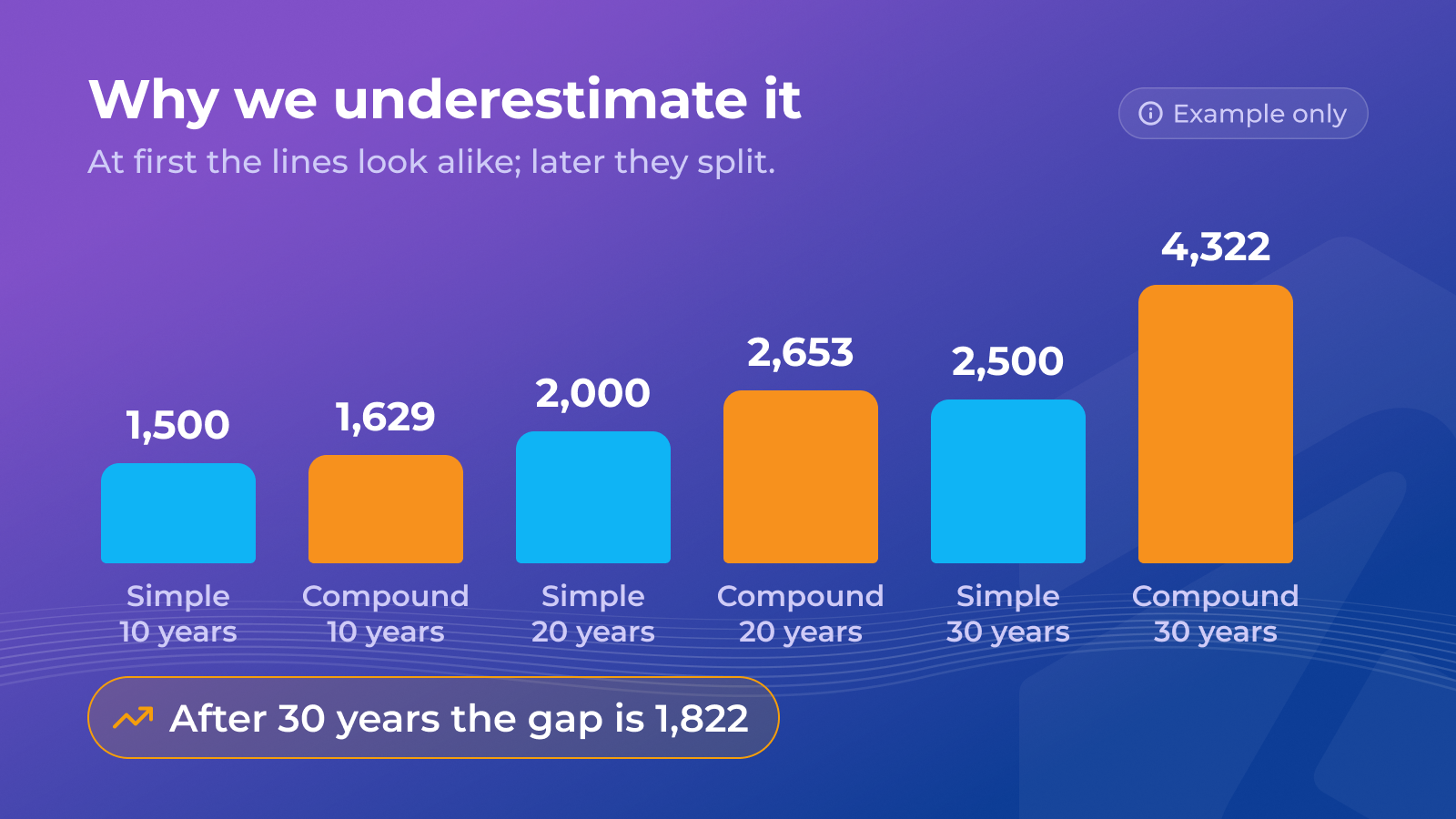
Our brains think in straight lines. Researchers call the habit of underestimating compounding exponential growth bias.
Look at the gap between simple and compound interest at 5% (Example only):
- after 10 years: 1,500 vs 1,629 (a gap of 129)
- after 20 years: 2,000 vs 2,653 (a gap of 653)
- after 30 years: 2,500 vs 4,322 (a gap of 1,822)
For the first years the two lines look almost the same, which is why compounding feels unimpressive at the start. Then the curve pulls away. Time does most of the work, and that's why the next chapters keep coming back to it.
It works both ways
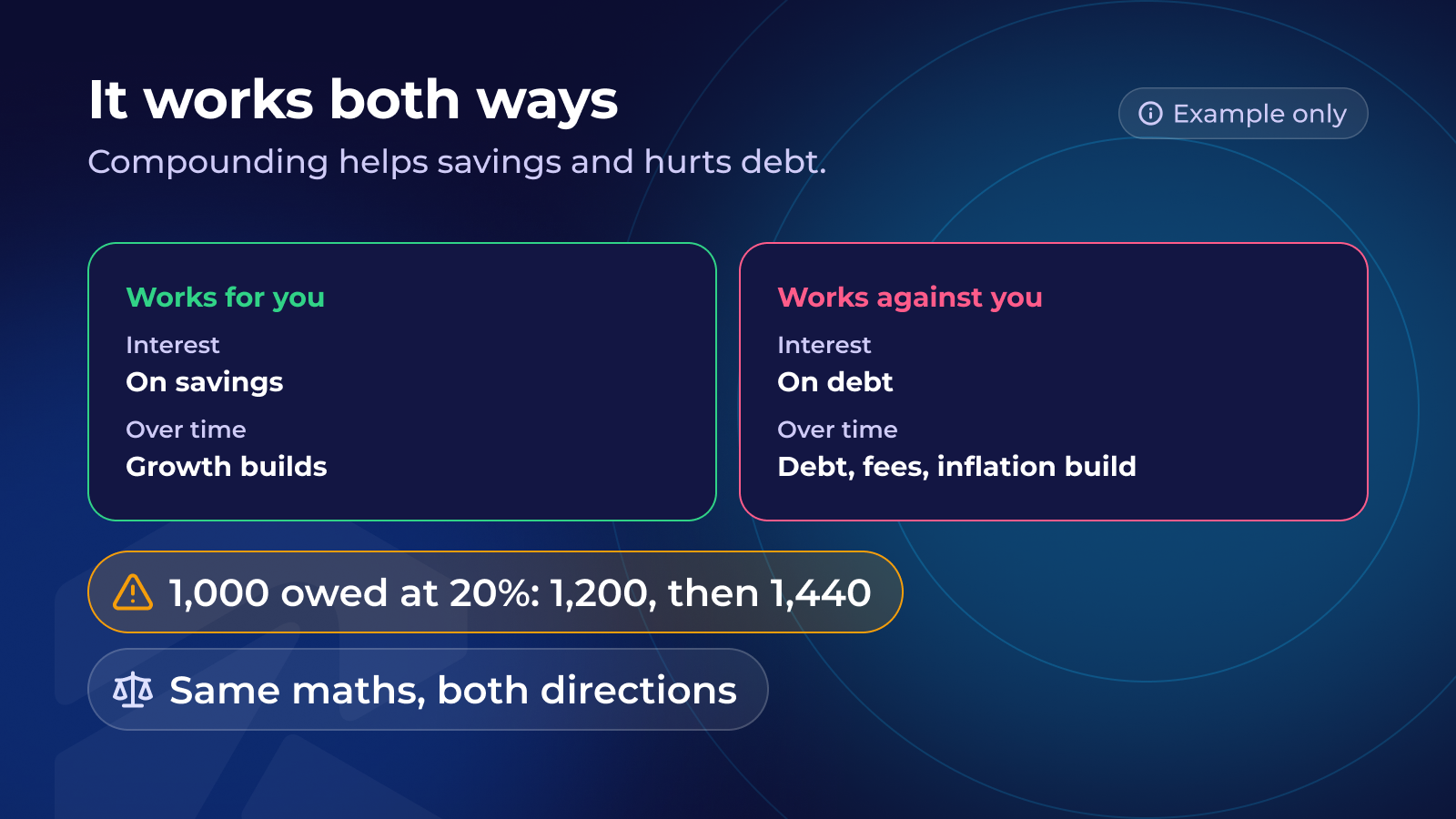
Compounding isn't only good news. The same maths works against you:
- Debt: unpaid interest on a card or loan is added to what you owe, and then charged interest itself. A 1,000 balance at 20% a year becomes 1,200, then 1,440 if nothing is paid.
- Fees: a yearly fee taken from a balance also compounds: it removes money that would have grown (Real Returns: After Inflation and Fees).
- Inflation: rising prices compound too, shrinking what money buys year after year.
- Losses: after a fall of 50%, a balance needs a rise of 100% just to get back.
And the rates in these examples are made up. Real savings rates change, and nothing guarantees a rate for 30 years.
Quick check
Compounding and debt: a 1,000 credit card balance is charged 20% a year and nothing is paid. Roughly how much is owed after two years, before any fees?
Quick check
Compound vs simple interest: two accounts both pay 4% a year on 1,000. One pays simple interest, the other compounds yearly. Which statement is true?
Recap: simple vs compound

- Simple interest grows in a straight line; compound interest earns interest on interest.
- The gap is small at first and large later: time does the work.
- Compounding also works against you: debt, fees, inflation and losses.
Next: how can you estimate compounding in your head? The Rule of 72
Lesson complete!
0 / 4
That's the first chapter. Continue this course — and unlock the rest — in the Rumos app.