How a Coin Moves from A to B
Follow one payment
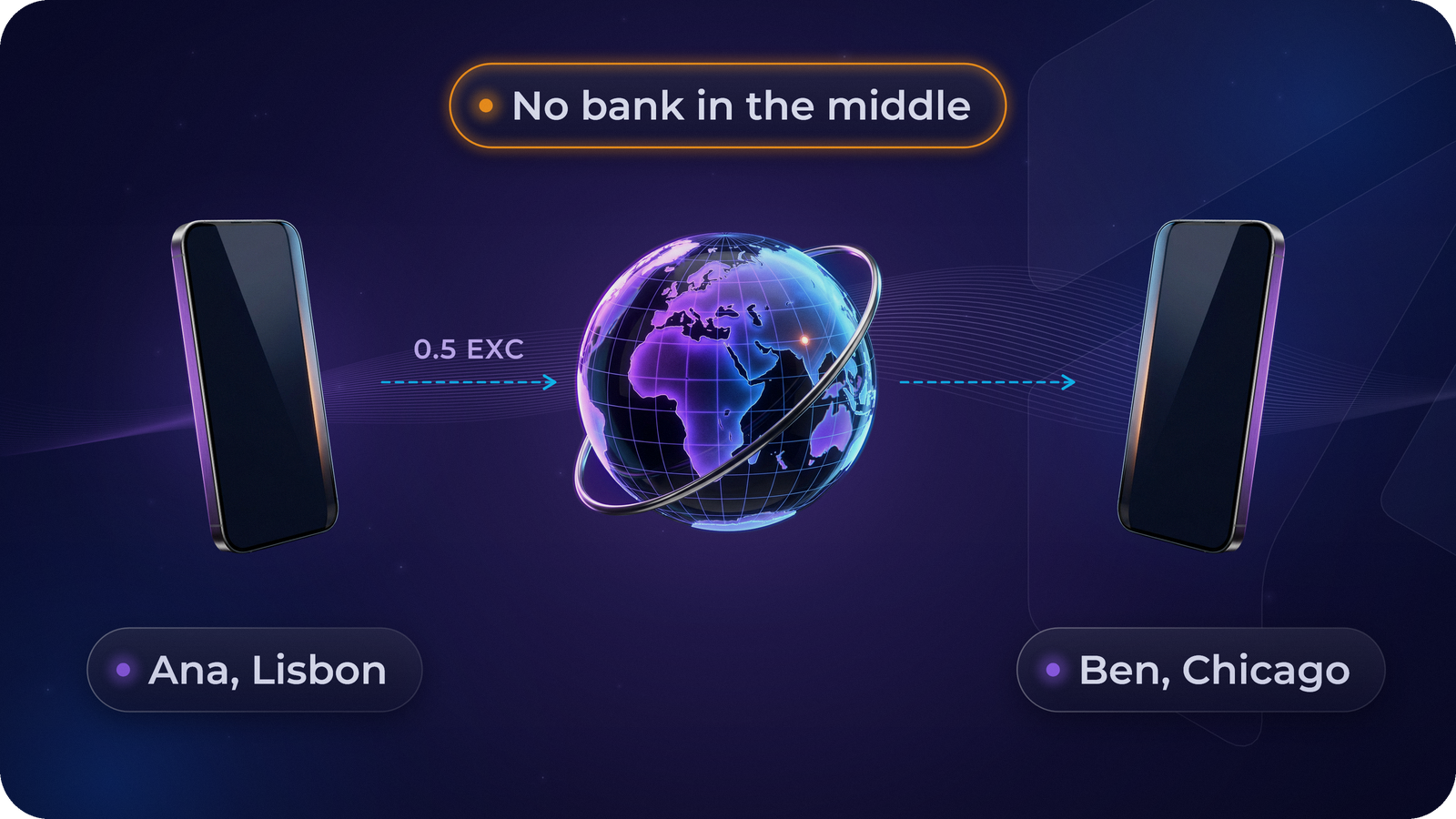
Ana lives in Lisbon. Her friend Ben lives in Chicago. Ana owes Ben for concert tickets and decides to pay him in crypto. No bank is involved in this payment. So who makes sure it arrives, that Ana really has the money, and that she can’t spend it twice?
In this chapter we follow Ana’s payment step by step, using a fictional coin, Examplecoin (EXC). The steps work in a similar way on Bitcoin, Ethereum and most other networks. (New to crypto? Start with What Is Crypto? The Big Picture.)
Ana has 2 EXC at her address. She wants to send Ben 0.5 EXC.
Step 1: Ana signs the payment
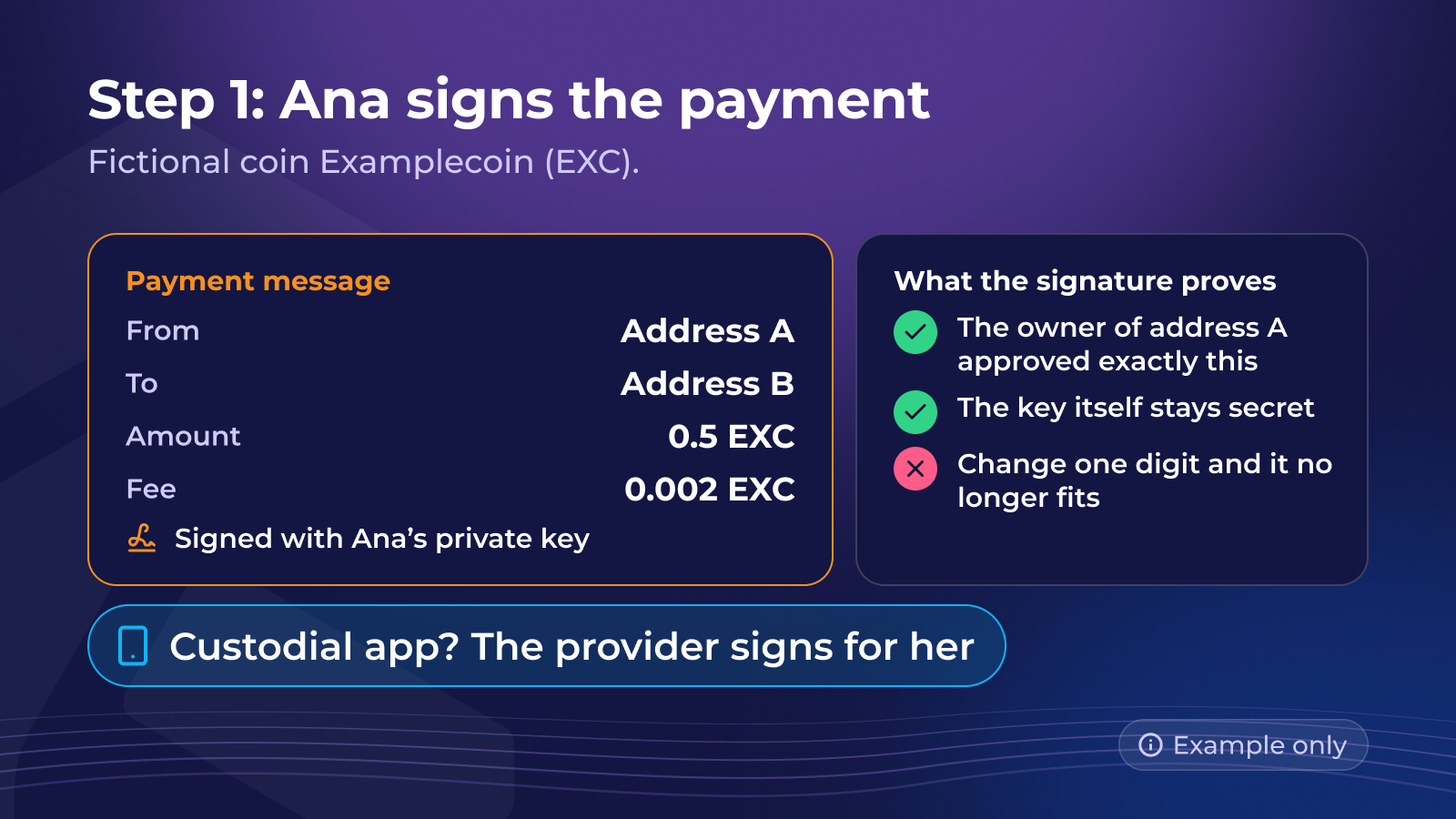
Ana’s wallet app writes a short message: “Move 0.5 EXC from address A to address B. Fee: 0.002 EXC.” Ben’s address is a long string of letters and numbers that he sent her, a bit like an account number.
Then the wallet signs the message with Ana’s private key. A digital signature is maths that proves the owner of address A approved exactly this payment, without revealing the key itself. If anyone changed a single digit of the amount or the address, the signature would no longer fit.
If Ana used a custodial app, the provider’s systems would sign on her behalf. The rest of the journey is the same.
Quick check
Ana sends crypto, and her wallet signs the payment with her private key. What does that digital signature prove to the network?
Step 2: The network checks it
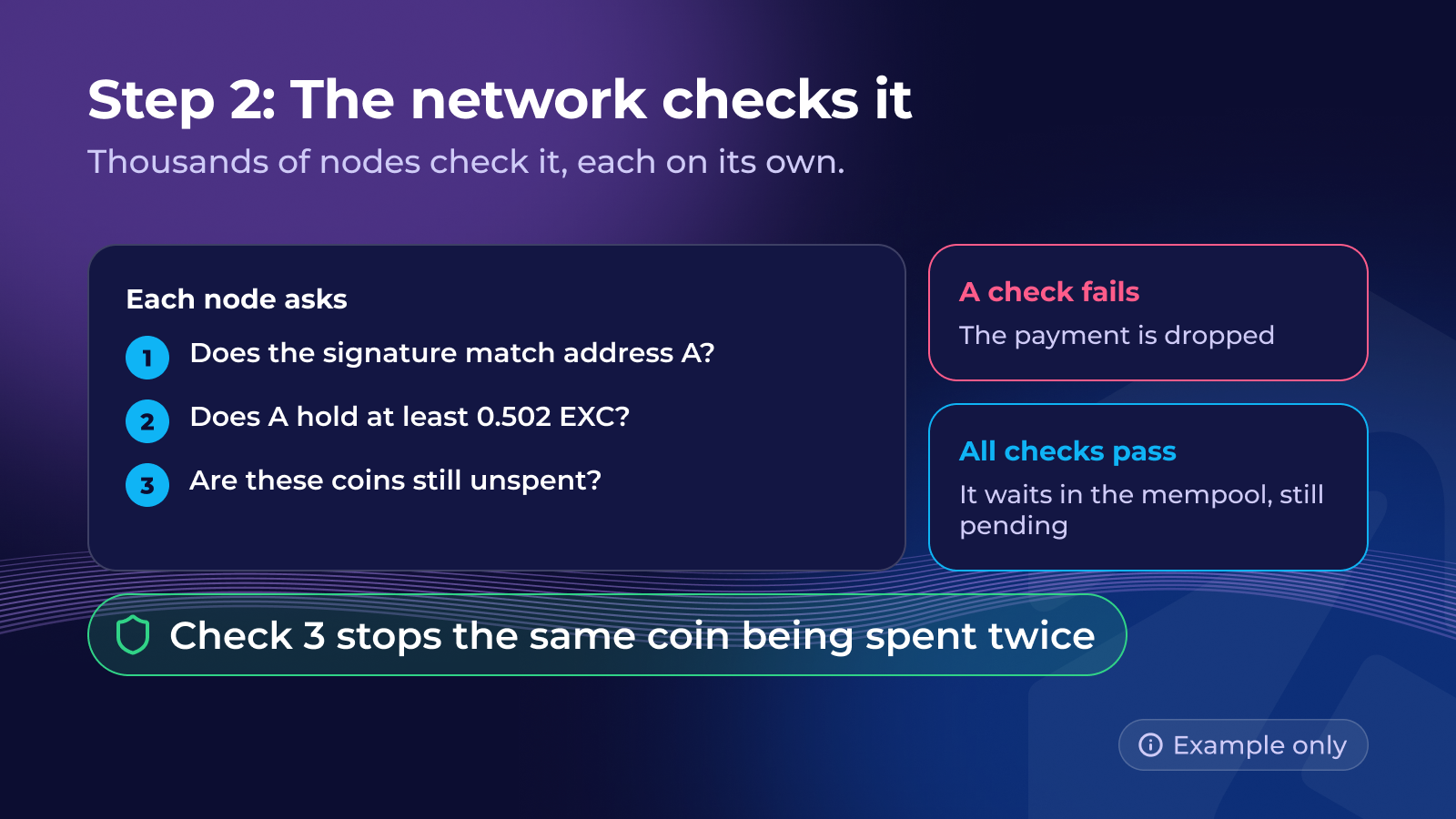
Ana’s wallet sends the signed message to the network. Within seconds it reaches thousands of computers called nodes. Each one checks three things on its own:
- Does the signature match address A?
- Does address A really hold at least 0.502 EXC?
- Have these coins not already been spent somewhere else?
If any check fails, the nodes drop the payment. If it passes, it waits in a queue of pending transactions, often called the mempool. Ben’s wallet may already show it as “pending”, but it isn’t settled yet.
The third check solves the old problem of digital money: copying a file is easy, but spending the same coin twice is not.
Step 3: Into a block, onto the chain
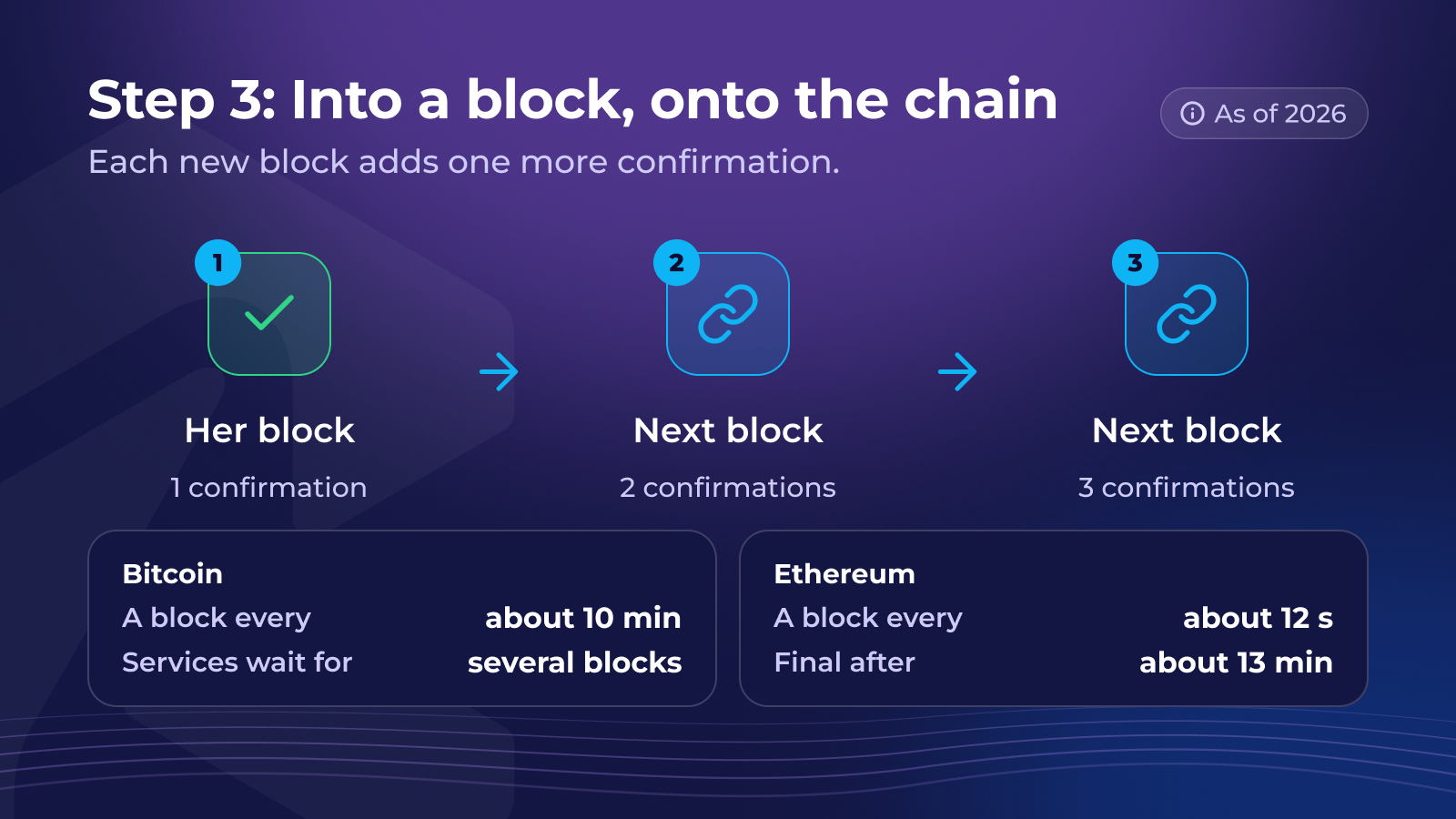
Next, a miner or validator picks pending payments, usually favouring those that pay higher fees, and bundles them into a new block. When the network accepts that block, Ana’s payment is recorded: that is its first confirmation. The 0.002 EXC fee goes to whoever added the block (on some networks, such as Ethereum, part of the fee is burned instead).
Every block added afterwards is one more confirmation, and each one makes the payment harder to undo. How long this takes depends on the network. On Bitcoin a new block arrives about every 10 minutes, and many services wait for several confirmations. On Ethereum (as of 2026) a new block comes about every 12 seconds, and payments are treated as final after about 13 minutes.
Quick check
A crypto wallet shows an incoming payment as “pending”. What is happening?
The whole payment, in numbers
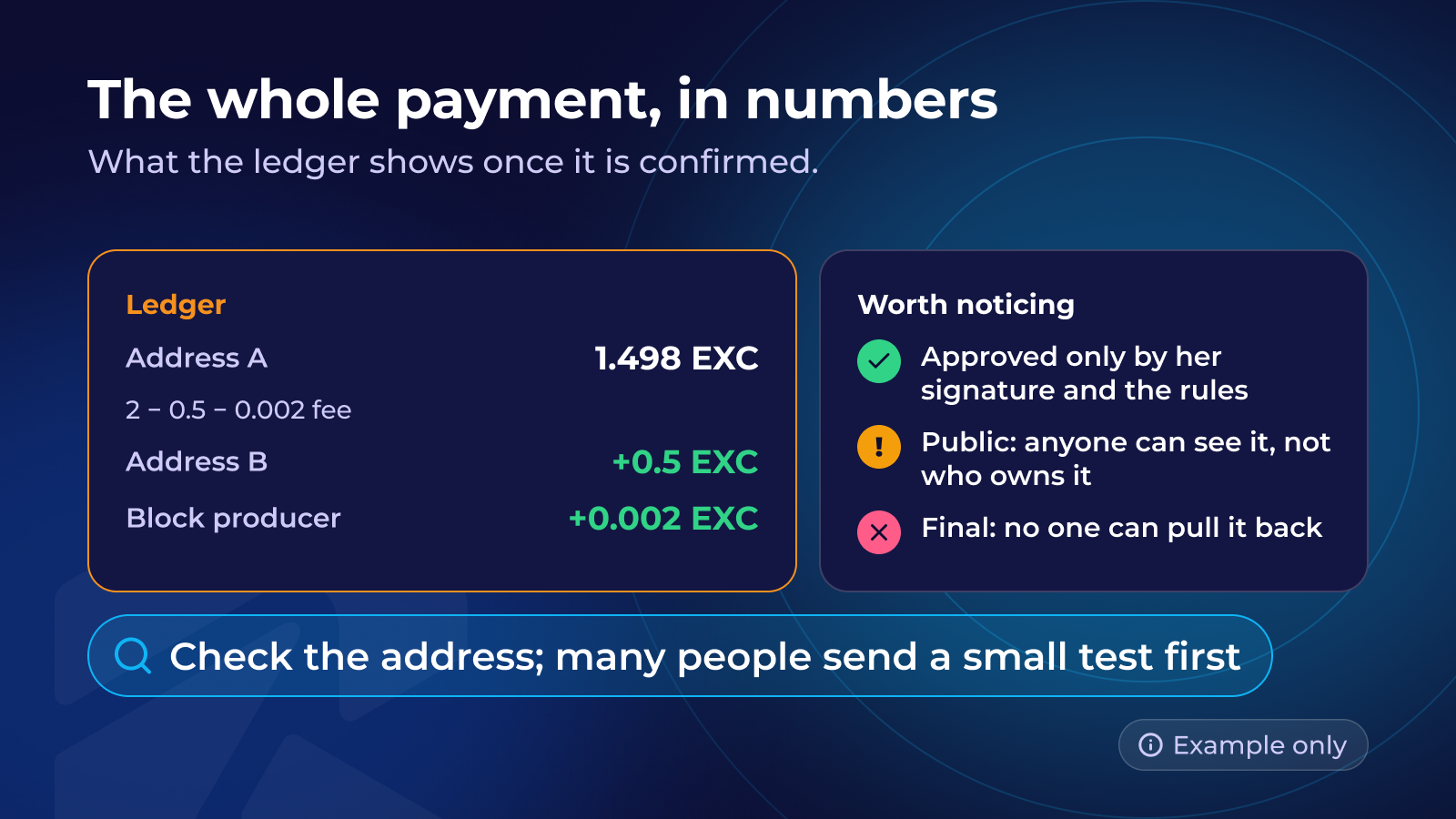
Here’s what the ledger shows once the payment is confirmed:
- Address A: 2 EXC − 0.5 EXC − 0.002 EXC fee = 1.498 EXC
- Address B: +0.5 EXC
- The block producer: +0.002 EXC fee
Three things are worth noticing. Nobody approved it except Ana’s signature and the network’s rules. It is public: anyone can see that address A sent 0.5 EXC to address B, though not who owns them. And it is final: if Ana had mistyped Ben’s address, no bank could pull the money back.
That’s why wallets ask you to double-check addresses, and why many people send a small test amount first.
Quick check
Ana pasted the wrong address for a crypto payment, and the payment is already confirmed. Who can reverse it?
Recap: one payment, start to finish
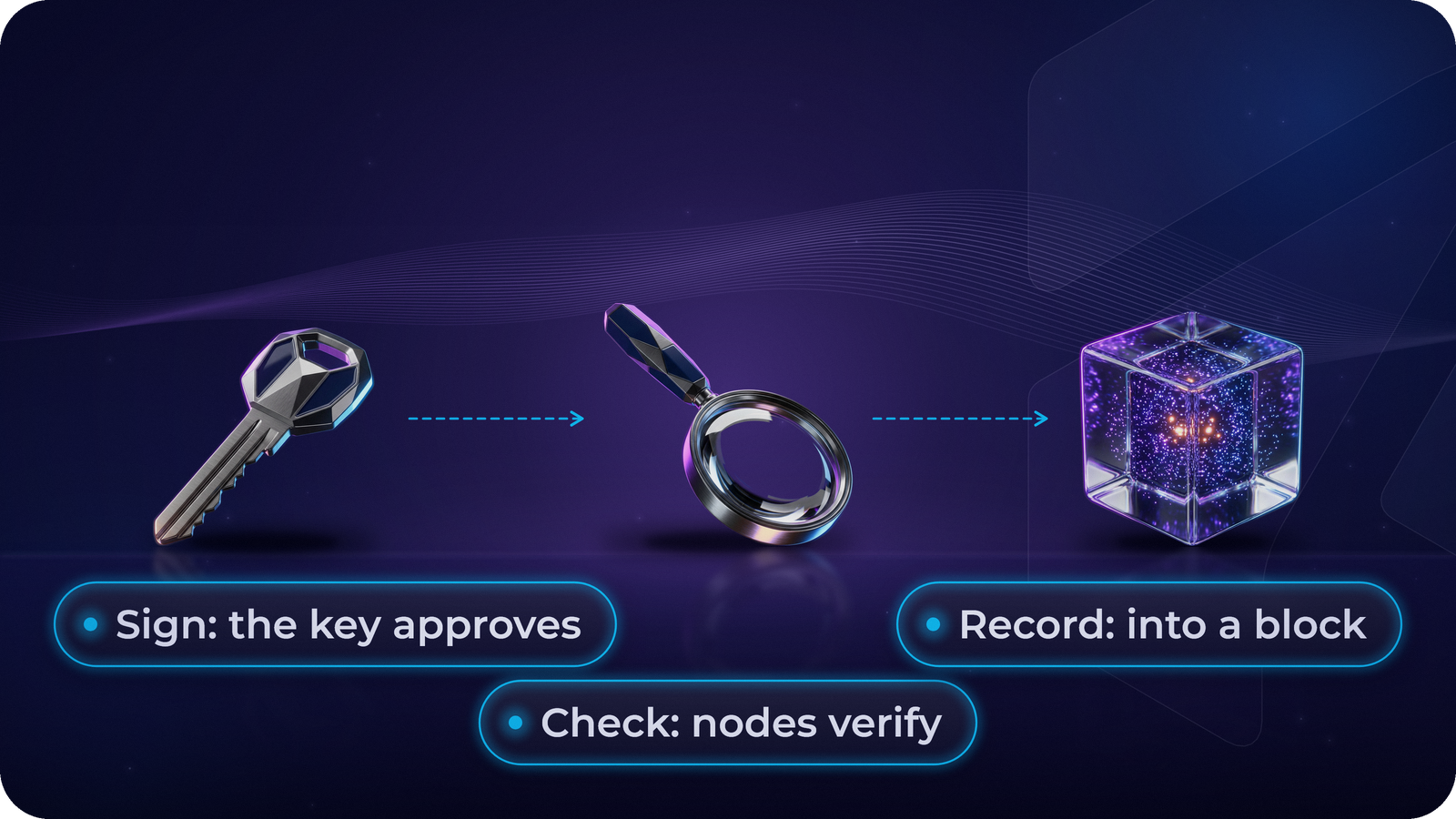
- Sign: the sender’s key approves an exact message.
- Check: independent nodes verify the signature, the balance and that nothing is spent twice.
- Record: a miner or validator adds it to a block; each new block adds a confirmation.
No one is in charge of the payment, which is also why no one can undo it. Always check the address and the network before you send.
Next: if no one is in charge, who runs the network? See Decentralisation: Who’s in Charge?
Lesson complete!
0 / 3
That's the first chapter. Continue this course — and unlock the rest — in the Rumos app.