What is Bitcoin?
Bitcoin in one minute
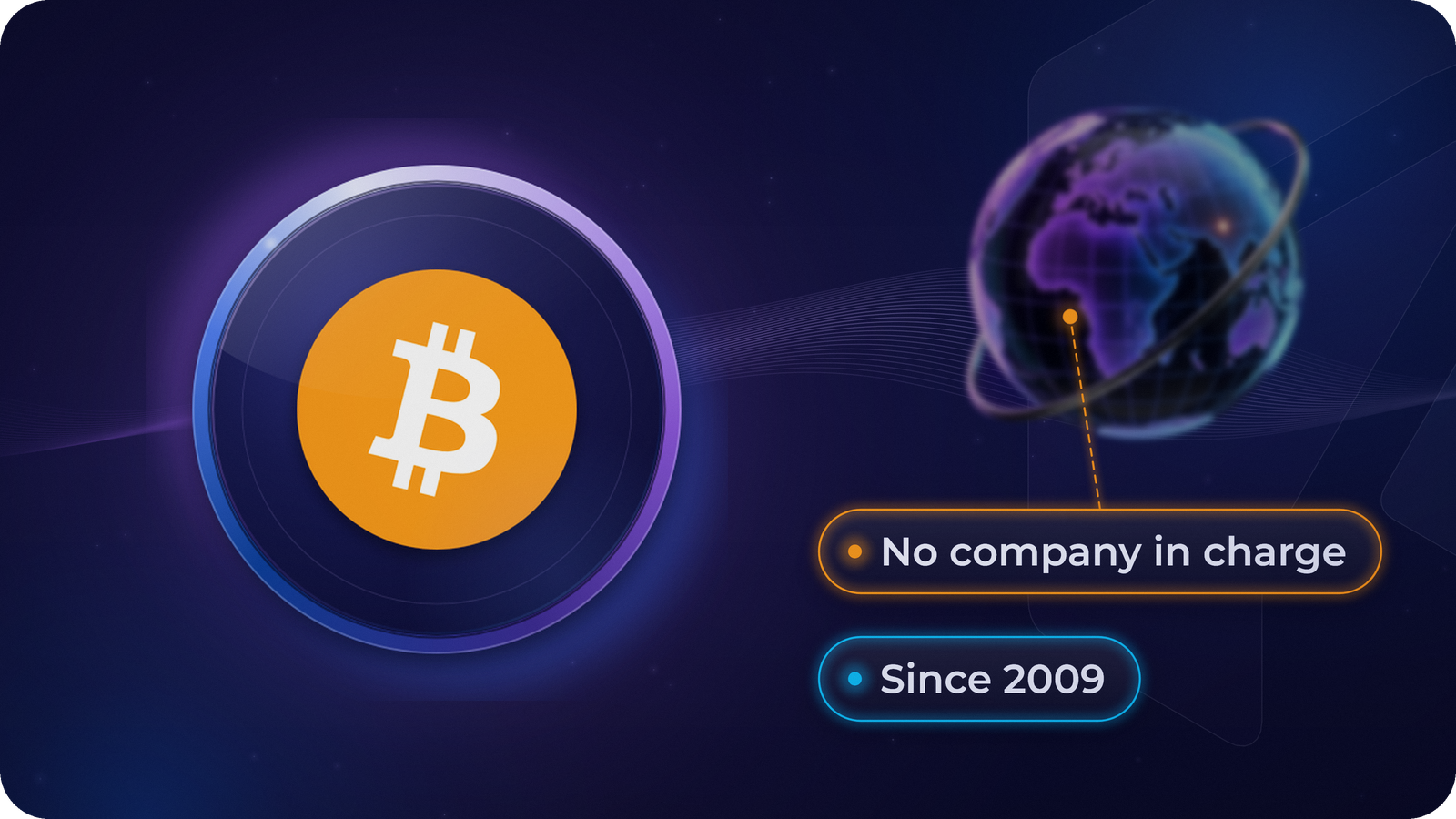
Imagine sending money to anyone in the world, at any hour, without a bank in the middle. That was the idea behind Bitcoin.
Bitcoin (BTC) was the first cryptocurrency. It started in January 2009, a few months after a person or group using the name Satoshi Nakamoto published a nine-page white paper. Nobody knows for sure who Satoshi is.
Bitcoin runs on a public ledger, the blockchain, which thousands of computers around the world keep in sync. No company, bank or government issues it, and nobody can change its rules alone.
People use it in two main ways: to send value over the internet, and as an asset they hold. Some call it “digital gold”. That is a comparison some people make, not a fact about its future value.
Quick check
What makes Bitcoin different from the euros or dollars in your bank account?
Key facts: supply, mining and halvings
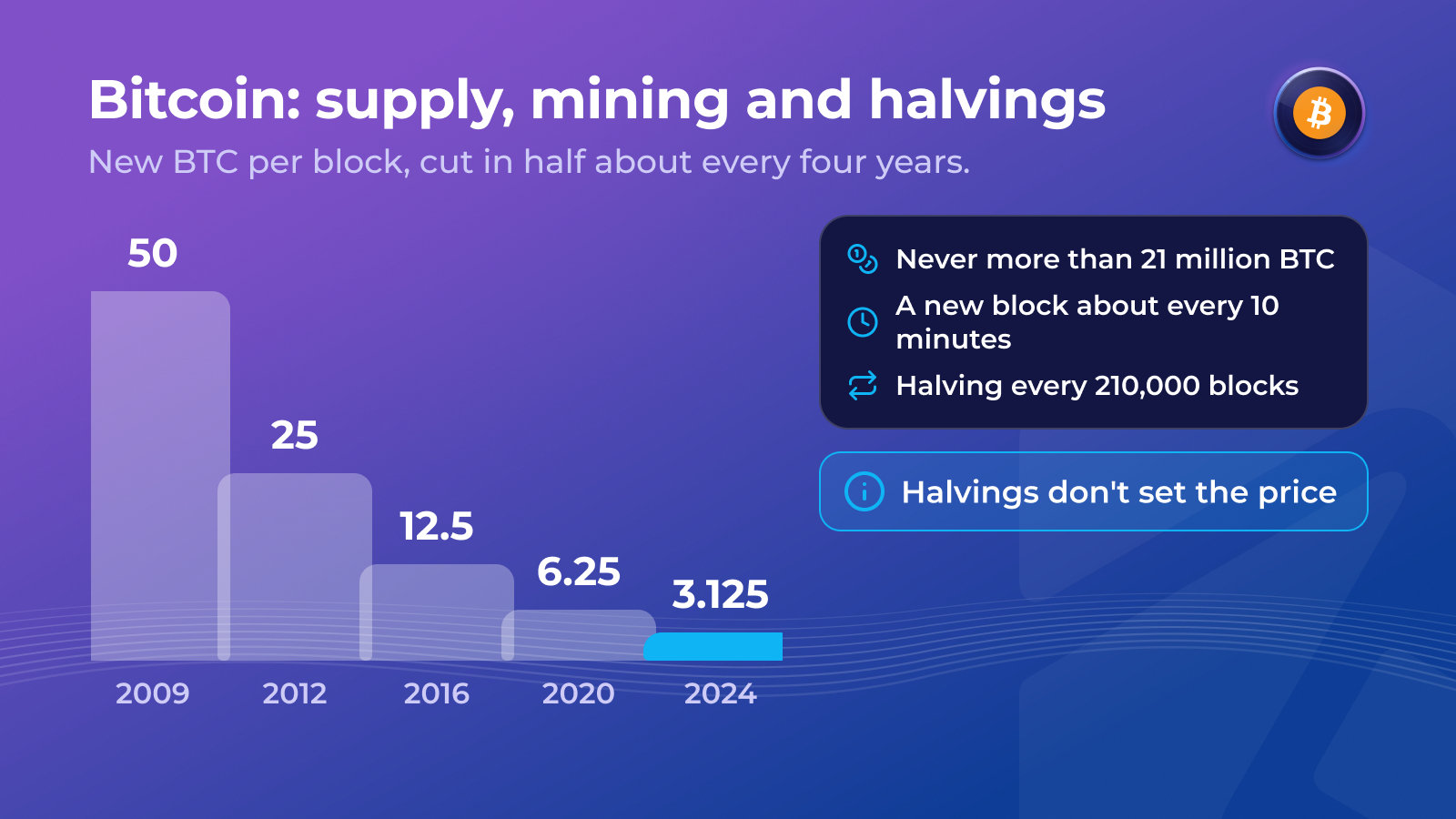
Supply. There will never be more than 21 million BTC. More than 20 million already existed in March 2026; the rest will be created more and more slowly until around 2140.
Mining. Computers called miners compete to add the next block, about every 10 minutes. This is proof of work: it costs electricity, which makes cheating expensive. The winner gets newly created bitcoin.
Halvings. Every 210,000 blocks (about four years) that reward is cut in half: from 50 BTC per block in 2009 to 3.125 BTC since 20 April 2024 (the picture). Halvings slow down new supply. They do not decide the price.
What it's used for, and what it isn't
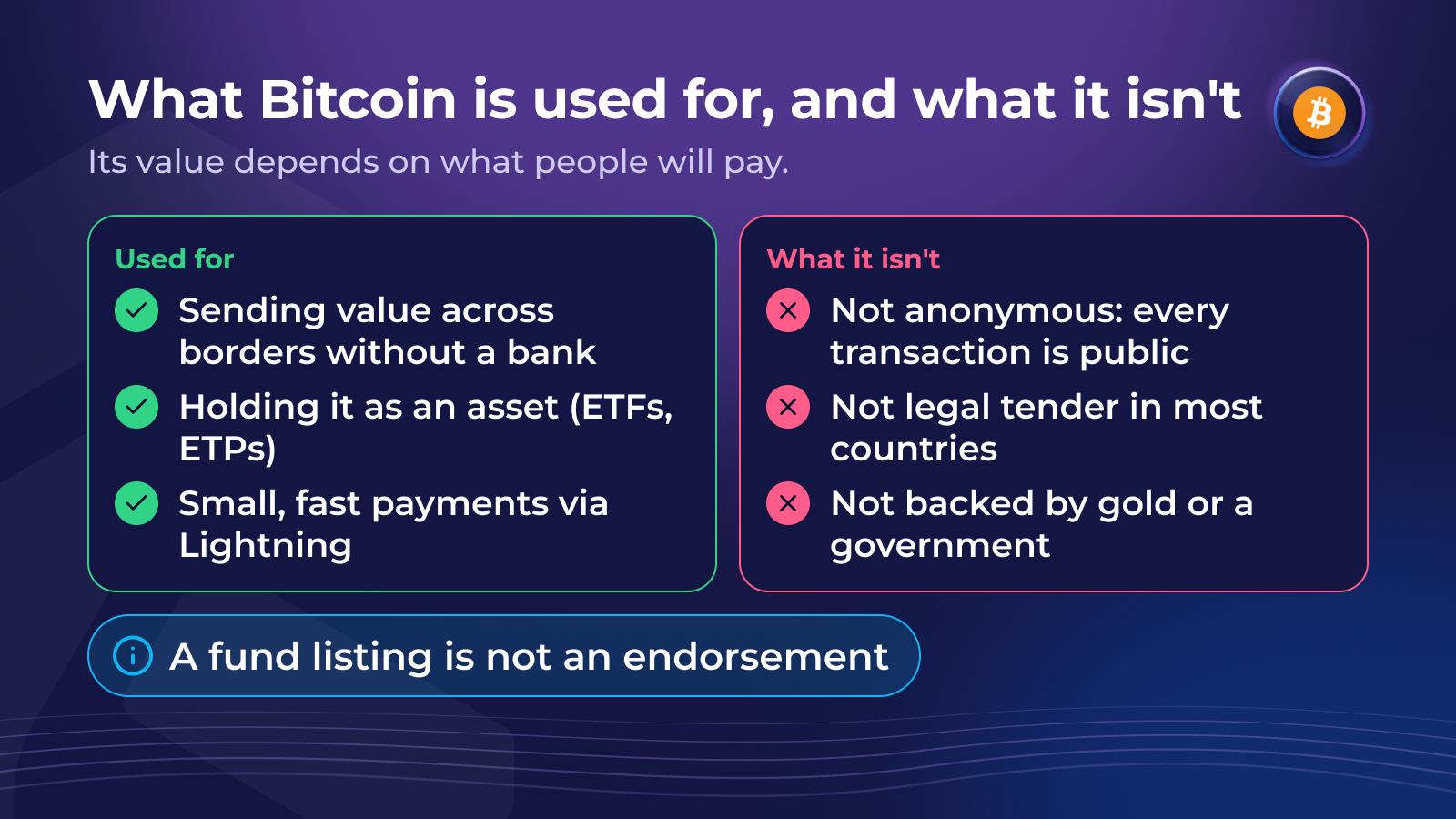
Used for:
- Sending value across borders without a bank. A new block confirms transfers roughly every 10 minutes; for large amounts, people often wait for several blocks.
- Holding it as an asset. In the US, spot Bitcoin ETFs (funds that hold bitcoin and trade on stock exchanges) have existed since January 2024; in Europe, similar exchange-traded products (ETPs) have been listed for years. A listing is not an endorsement by regulators and doesn't reduce the price risk.
- Small, fast payments through the Lightning Network, a payment layer built on top of Bitcoin.
What it isn't: it is not anonymous (every transaction is public, only the names are missing). It is not legal tender in most countries. And it is not backed by gold or a government: its value depends on what people are willing to pay for it.
Quick check
Which statement describes how Bitcoin is used today?
Risks and controversies
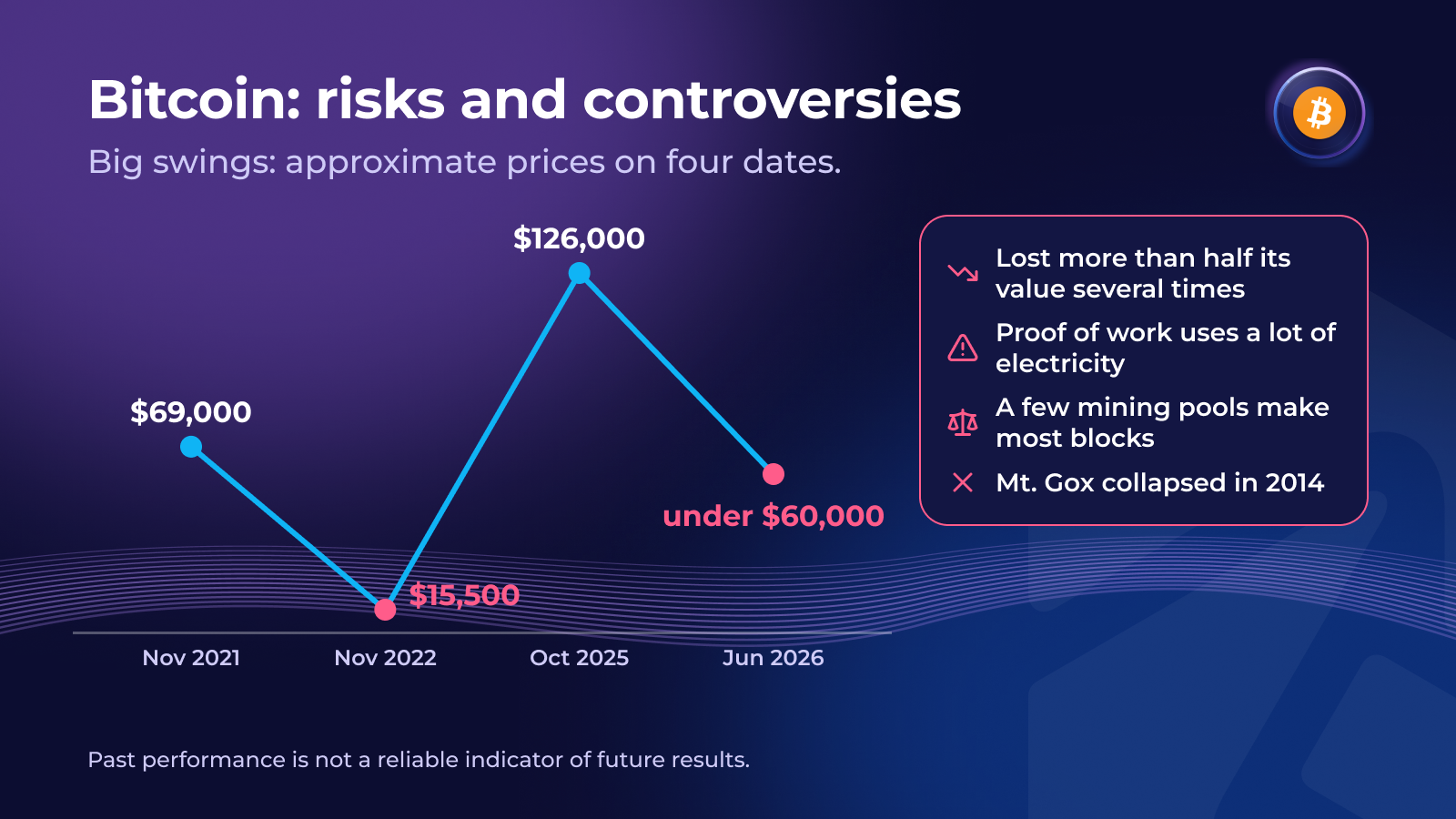
Big price swings. Bitcoin has lost more than half its value several times. It fell from about $69,000 in November 2021 to about $15,500 in November 2022, rose to about $126,000 on 6 October 2025, and fell to about $58,500 on 1 July 2026 (approximate prices from public market data such as CoinGecko; the picture shows these four dates only).
Energy. Proof of work uses a lot of electricity, and its environmental impact is widely criticised.
Concentration. As of 2026, a handful of large mining pools put together most new blocks.
Mistakes and failures. Transactions can't be reversed, and lost keys mean lost coins. The Mt. Gox platform collapsed in 2014 after hundreds of thousands of BTC went missing.
Past performance is not a reliable indicator of future results.
Crypto prices can rise and fall sharply, and you could lose some or all of the money you put in. Crypto is not covered by deposit protection. This lesson is education, not financial advice.
Quick check
A post says: “Bitcoin's supply is capped, so its price can only go up.” What's the problem with this claim?
Recap: Bitcoin in three lines
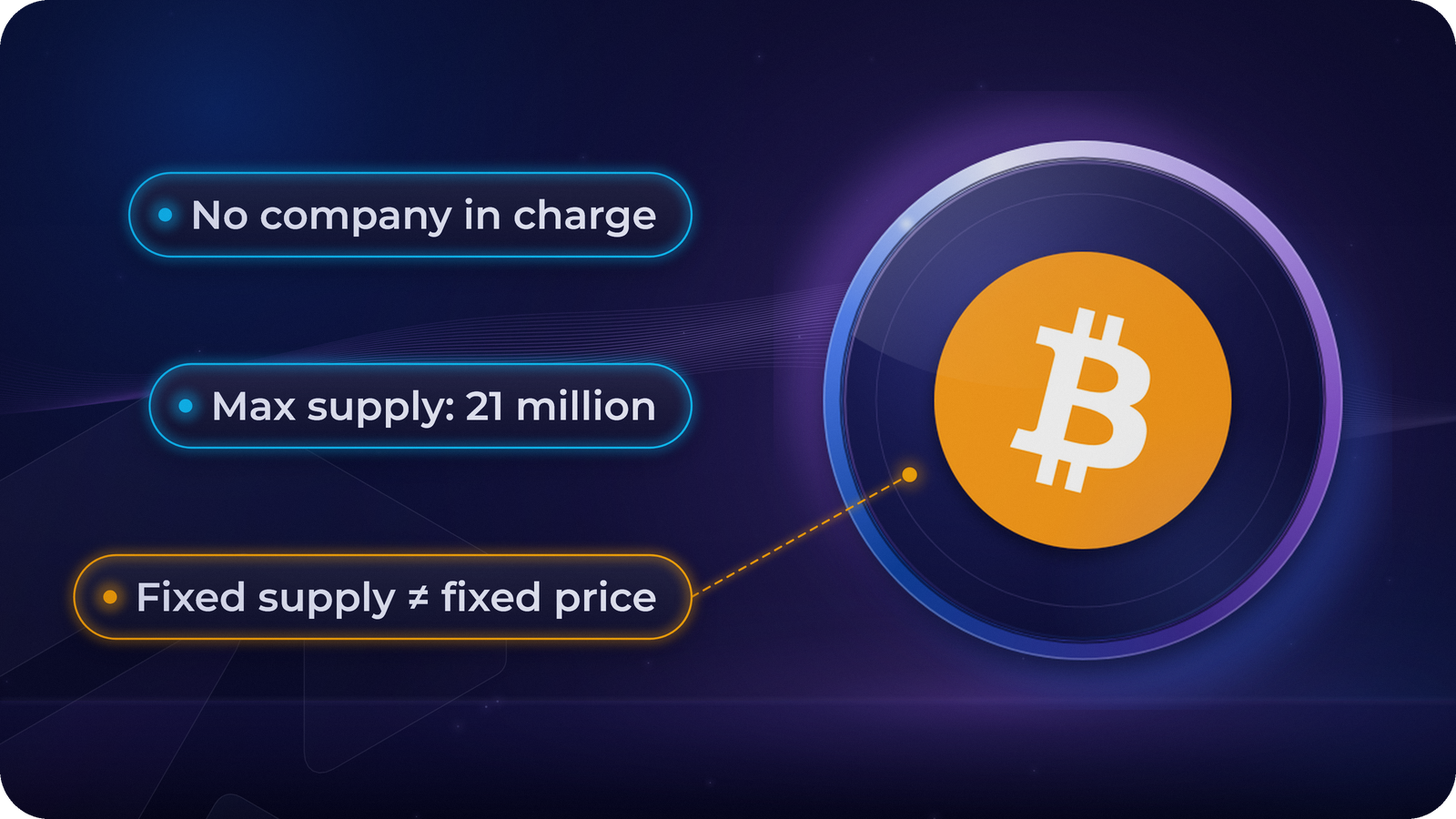
Remember:
- Bitcoin (2009) is the first cryptocurrency: a public ledger run by a network, with no company or government in charge.
- Supply is capped at 21 million. New coins come from mining, and halvings slow that down.
- Its price has swung hard in both directions. A fixed supply is not a promise of value.
See the Bitcoin page in the app for its current data: Bitcoin (BTC).
Crypto prices can rise and fall sharply, and you could lose some or all of the money you put in. Crypto is not covered by deposit protection. This lesson is education, not financial advice.
Next: What is Ethereum?, a blockchain that runs programs, not just payments.
Lesson complete!
0 / 3
That's the first chapter. Continue this course — and unlock the rest — in the Rumos app.