EducationBeginner7 min
Where does an exchange keep your crypto, and what happens when one is hacked?
At an exchange, the company controls the keys to your crypto. This explainer covers hot and cold wallets, multisig and MPC, what proof of reserves and funds like SAFU do and don't show, what MiCA requires of authorised firms, and the trade-offs of self-custody.
By Rumos · yesterday
In this article
- What does it mean that an exchange "holds" your crypto?
- What are hot wallets and cold wallets?
- How do exchanges guard the keys?
- What is proof of reserves, and what doesn't it show?
- What is an insurance-style fund like SAFU?
- What does EU law require of licensed firms?
- Self-custody or a company: what are the trade-offs?
- Which habits help?
- What to take from this
- What you can do now
- Questions readers ask
When you buy crypto on an exchange, your balance looks like coins in a drawer with your name on it. It isn't, and that matters when things go wrong. On 29 October 2026, attackers took about $6.3bn from Binance's online "hot" wallets, according to the exchange, which paused withdrawals until a phased restart on 1 November. Here is how custody works.
Key points: where does an exchange keep your crypto?
- The exchange holds the keys; your balance is its record of what's yours.
- Some funds stay in online "hot" wallets for withdrawals, which are more exposed to attacks.
- Proof of reserves is a snapshot, not an audit. Funds like SAFU are company reserves, not a legal guarantee.
- In the EU, MiCA's rules on segregation and liability apply only to authorised firms.
- Self-custody and using a company carry different risks; neither is risk-free.
What does it mean that an exchange "holds" your crypto?
A wallet doesn't store coins. The US Securities and Exchange Commission (SEC) says wallets "store the 'private keys' or passcodes for your crypto assets". A private key is like a password for moving the coins. Lose it, and access is lost for good.
On an exchange, the company manages those keys for you: that is custody. Your balance is its record of what's yours, backed by coins whose keys it controls. If the custodian "is hacked, shuts down, or goes bankrupt, you may lose access," the SEC warns. New to this? Start with basics about cryptocurrencies.
What are hot wallets and cold wallets?
Think of a shop. The cash register out front holds what the day needs; the vault in the back holds the rest and is slower to reach.
A hot wallet is the register: connected to the internet, convenient, but exposed to cyberthreats. A cold wallet is the vault: typically an offline device, such as a USB drive, or even paper. The SEC calls cold wallets less convenient but generally better shielded from cyberthreats. Devices, though, can be lost, damaged or stolen.
Many exchanges say they keep most customer coins offline and a working balance online for withdrawals. Even a small online share of a big exchange can mean billions. Our course on storing cryptocurrencies covers both.
How do exchanges guard the keys?
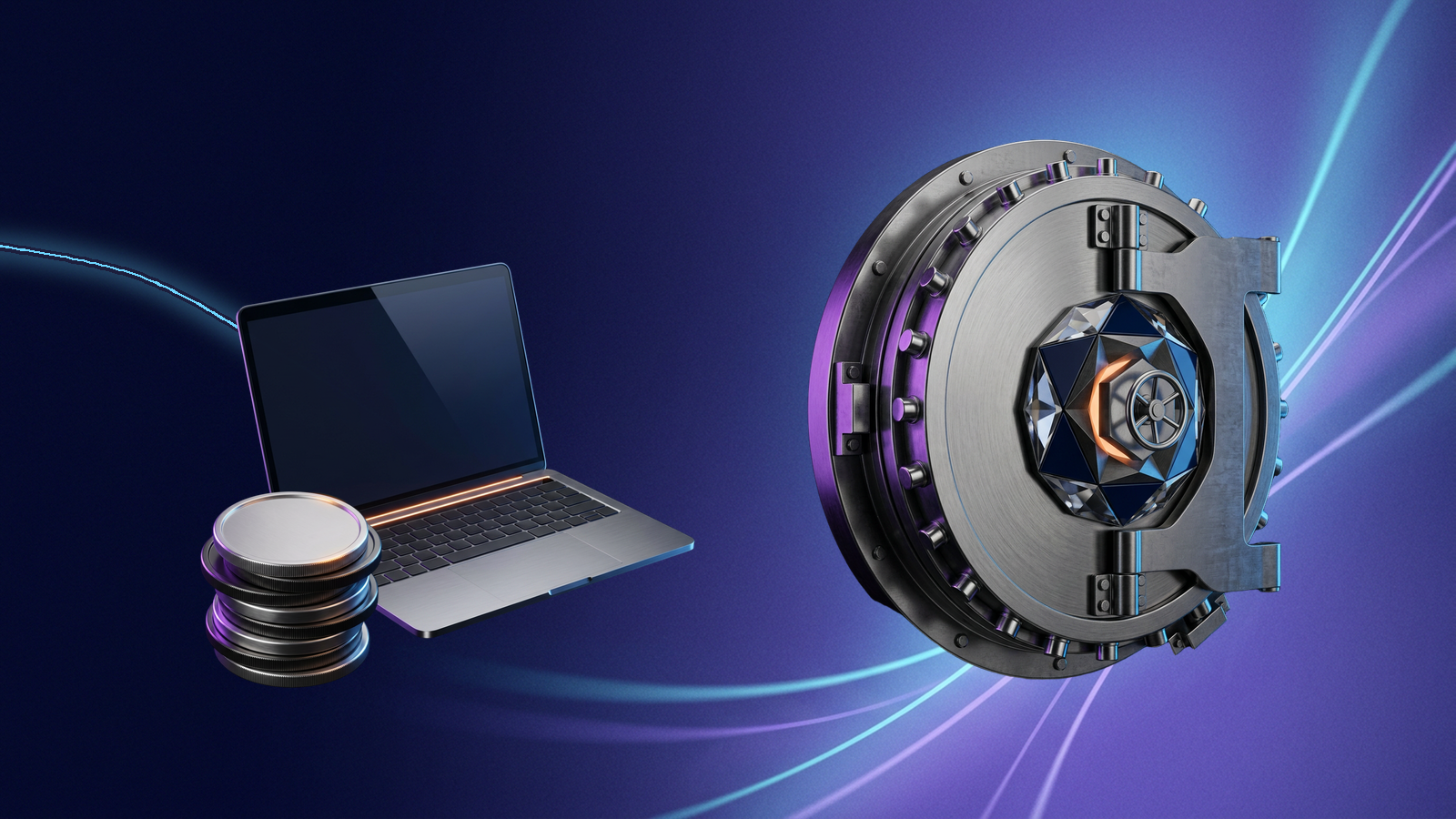
The big risk is one person or machine holding a key to everything. Two common techniques spread that power:
- Multisig (multi-signature): a transaction needs several keys, for example 2 of 3, like a box that opens only when two of three keyholders turn their keys.
- MPC (multi-party computation, or threshold cryptography): one key is split among several parties or machines, so no single one holds all of it.
These tools guard the key, not the approval process around it. In the 2025 Bybit hack, which drained a multisig cold wallet, attackers compromised the people and systems around the wallets, not the cryptography, says analytics firm Elliptic. So read "multisig" or "MPC" as "no single person can move funds alone", not "hacks are impossible". More in our introduction to security.
What is proof of reserves, and what doesn't it show?
Proof of reserves is an exchange's report of the crypto it holds against customer balances. Some let you check that your balance was included, and prove reserves cover balances at least one-to-one without revealing anyone's.
Staff at the US audit regulator PCAOB say such reports cover "a particular moment in time", likely don't address the firm's debts, and give no assurance about what happens to the assets afterwards. "PoR engagements are not audits," they wrote. It's a bank statement for one second. A hot wallet drained on 29 October had been listed in Binance's 1 October report, CoinDesk reported.
What is an insurance-style fund like SAFU?
SAFU is Binance's emergency fund. Binance describes it as a reserve set up in July 2018 for extreme cases such as security breaches, funded from a percentage of trading fees.
A fund like this is the company's own: it decides whether and how to use it, within what it can afford. No public scheme guarantees crypto. MiCA makes issuers' information documents state that crypto is not covered by EU deposit guarantee or investor compensation schemes, and the US deposit insurer, the FDIC, says its insurance doesn't apply to crypto.
What does EU law require of licensed firms?
MiCA, the EU's crypto rulebook, covers licensed firms that hold clients' crypto or its keys. The MiCA text requires, among other things:
- Safekeeping (Art. 70): "adequate arrangements to safeguard the ownership rights of clients", especially in insolvency, and no use of clients' crypto for the firm's own account.
- Segregation (Art. 75): clients' crypto kept apart from the firm's own, including on the blockchain, and out of reach of the firm's creditors if it fails.
- Liability (Art. 75): the firm is liable for crypto lost in an incident attributable to it, capped at its market value when lost, but not for events it shows were independent of its operations.
The catch: this covers only authorised firms. ESMA, the EU's markets supervisor, says clients of unauthorised providers "do not benefit from MiCA safeguards, including protections for client assets", and keeps a public register of authorised firms. Authorisation doesn't rule out hacks, but it tells you which rules apply. More in crypto rules in the EU.
Self-custody or a company: what are the trade-offs?
Self-custody means holding your own keys. Neither option removes risk.
- Self-custody: sole control, and sole responsibility. An exchange hack or bankruptcy doesn't directly touch your coins. But lose both your wallet and its seed phrase (the words that restore it), and the loss is usually permanent. Setup may take some know-how, and MiCA's custody rules don't apply.
- A company: account recovery is usually possible, and an authorised EU custodian must follow MiCA's segregation and liability rules. But you depend on its security, practices and ability to cover a loss, and withdrawals can be paused.
- Either way: phishing and malware on your own device remain a risk.
Which habits help?
- Never share your private keys or seed phrase, the SEC says.
- Use strong passwords and two-factor authentication (2FA), a second check beyond your password. The US cyber agency CISA urges "phishing-resistant" versions.
- Consider a withdrawal allowlist if offered: withdrawals go only to addresses you approved in advance.
- Expect phishing after big news. Fake "compensation" messages appear fast, sometimes alongside real promotions, so check only in the official app or website, never via a message link.
- Be wary of "recovery" offers. The FBI's IC3 calls them "a ruse to revictimize those who have already lost money".
What to take from this
At an exchange, your crypto is a balance backed by keys someone else controls, and attacks often hit the people and systems around those keys. Proof of reserves shows a moment, emergency funds are a choice, and EU duties apply only at authorised firms.
What you can do now
- Learn to spot fake refund and recovery messages in spot the scam.
- Bring questions about wallets and keys to our workshops.
Questions readers ask
If my exchange is hacked, will I get my crypto back?
It depends. An exchange may cover losses from its own funds, but that is its choice. Frozen stolen funds (blocked by a token's issuer) aren't automatically returned; recovery can take months or years. In the EU, an authorised custodian is liable for losses attributable to it.
Is a cold wallet hack-proof?
No. It is generally less exposed to online attacks, but the device can be lost, damaged or stolen.
Does proof of reserves prove an exchange has enough money?
Not on its own: it shows assets at one moment, and likely not the firm's debts.
Crypto prices can rise and fall sharply, and you could lose some or all of the money you put in. Crypto is not covered by deposit protection. This article is for education, not financial advice.