Market NewsBeginner10 min
Panic selling and FOMO: why beginners sell in a crypto drop and buy near the top
Two common beginner crypto mistakes are selling in a panic after prices fall and buying near a peak because of FOMO. Using bitcoin's record of about $126,000 in October 2025 and its fall below $56,000 in November 2026, this explainer covers why both happen and calm habits that help.
By Rumos ·

In this article
Two of the most common mistakes beginners make in crypto are mirror images of each other: selling in a panic after prices fall, and rushing in after prices have already risen a lot, often near the top, because it feels like everyone else is getting ahead. Bitcoin's moves between October 2025 and November 2026 show how strong both pulls can be. It reached a record of about $126,000 on 6 October 2025, according to CoinMarketCap, and fell below $56,000 on 21 November 2026, its lowest level since September 2024, according to Investing.com. This explainer covers why fear and FOMO happen, what each one costs, and calm habits that help you decide before your emotions do. It is about habits, not about whether to buy or sell.
Key points: why do beginners sell in a drop and buy near the top?
- Panic selling means selling because prices are falling and fear takes over, not because your plan has changed. Selling turns a fall on screen into a loss you actually take.
- FOMO, the fear of missing out, pulls people in after prices have already risen a lot, often close to a peak.
- Together they make a costly loop: buy high out of excitement, sell low out of fear. Morningstar found that US fund investors earned about 1.2 percentage points a year less than their funds over the 10 years to 2025, partly because of badly timed buys and sells.
- Past drops have sometimes been followed by recoveries and sometimes by further falls. Nobody knows in advance which one comes next.
- Calm habits help: only use money you can leave alone, write your plan before you buy, never borrow to buy, and wait a day before acting on a big price move.
Why do people panic sell when crypto drops?
People panic sell because a falling price feels like a threat, and the quickest way to make the feeling stop is to get out. Panic selling means selling because prices are dropping and fear has taken over, rather than because your reasons for owning something have changed.

Psychologists Daniel Kahneman and Amos Tversky described part of the reason in 1979: for most people, losing money feels stronger than gaining the same amount. In crypto, that feeling gets a lot of fuel. Prices move every second, phone apps show red numbers, and headlines and social media posts get louder as prices fall. Many beginners also put in more than they can comfortably leave alone, so a fall starts to feel like a personal emergency.
What does selling after a drop lock in?
Selling after a drop turns a fall on your screen into a loss you actually take. While you still hold a coin, a lower price is a loss on paper. Once you sell, the money you get back is fixed, whatever the price does next.
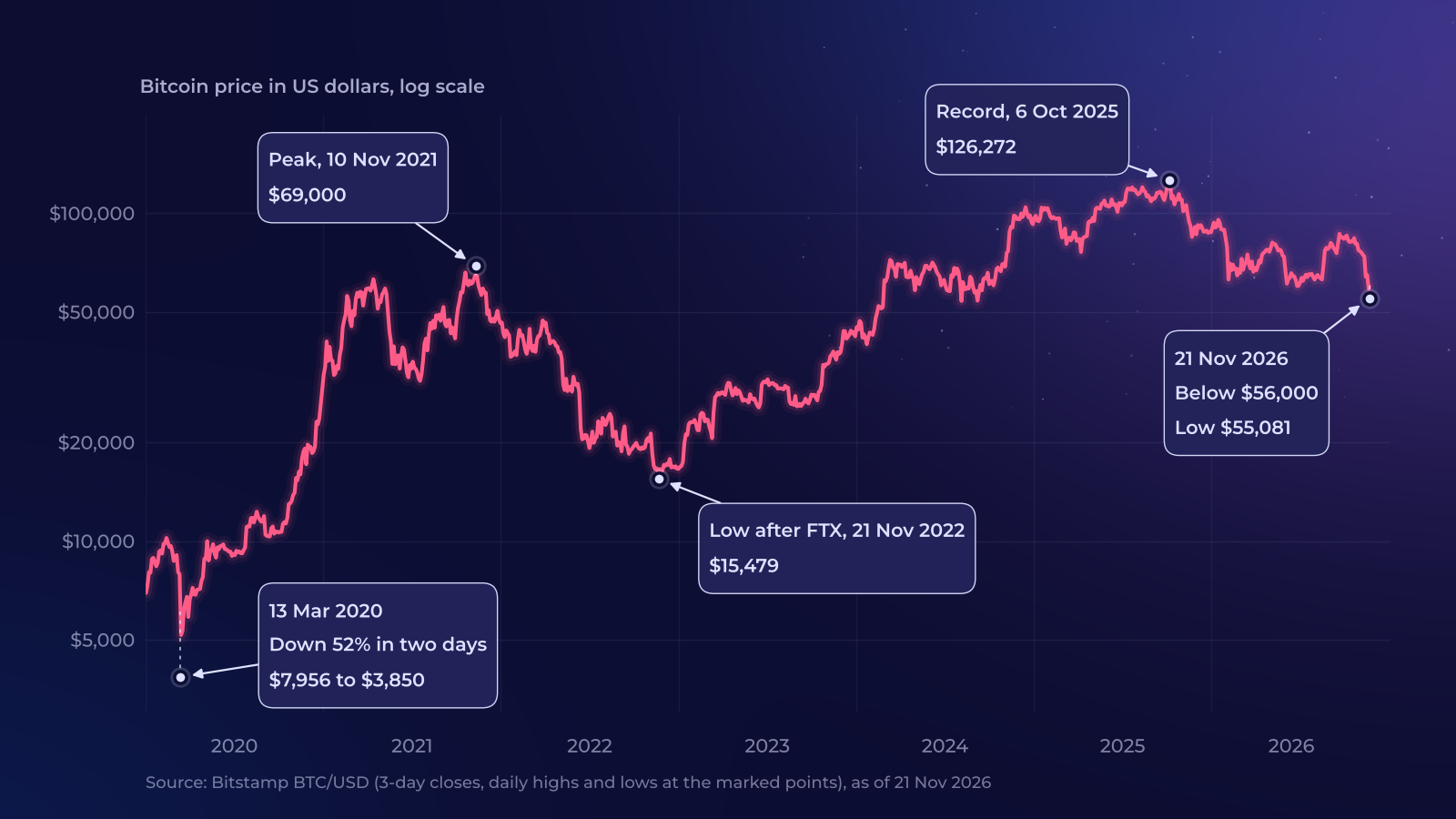
History shows why this matters, in both directions. In March 2020, as markets fell at the start of the Covid-19 pandemic, bitcoin dropped as much as 50% in two days, to $3,915 at its low on 13 March, according to Bloomberg. It took about a month and a half to win back those losses, according to Decrypt. People who sold at that low made the fall final just before prices rose again. But in 2022, bitcoin kept falling for most of the year and lost about 60% of its value, according to Reuters, as republished by The Star. People who held on through that year saw their losses grow, and some who sold early lost less. A drop is not a promise of a bounce, past recoveries say nothing about when, or whether, the next one comes, and holding on is not automatically the better choice.
That is why the useful question is not "will it go back up?", which nobody can answer, but "did I decide this before the drop, or am I deciding it because of the drop?"
What is FOMO, and why do people buy near the top?
FOMO, short for "fear of missing out", is the uneasy feeling that other people are getting ahead and you will be left behind unless you jump in quickly. In crypto it tends to peak when prices have already risen a lot, because that is when headlines, friends and social media talk about crypto the most.

The result is that many people buy for the first time near a peak. Bitcoin peaked at more than $68,000 in November 2021, and a year later it was below $18,000, according to CNBC. Someone who bought at the peak because it felt like everyone else was getting in would have seen most of that money disappear on screen within a year, which is exactly when panic selling becomes most tempting.
Why do the two mistakes feed each other?
FOMO and panic selling often happen to the same person, one after the other. Excitement pulls you in high, fear pushes you out low, and the gap between the two is the money lost.
This is not only a crypto problem. In its 2026 Mind the Gap study, Morningstar estimated that the average dollar invested in US mutual funds and ETFs earned about 1.2 percentage points a year less than the funds themselves returned over the 10 years to 31 December 2025. Morningstar explains the gap by when and how much people bought and sold, and names "buying high or selling low on impulse" as one way timing holds returns back. Crypto moves faster and further than most funds, so the same habits can cost more.
What calm habits help you avoid both mistakes?
The habits that help most are the ones you set up before prices move, because that is when you can think clearly. These are habits people use to keep emotions out of their decisions, not advice on what to buy or sell.

- Only use money you can leave alone. If you might need the money for rent, bills or an emergency in the next few years, a fall will force your hand. Money you won't need soon means a fall doesn't force a decision on you.
- Write your plan before you buy. Note why you are buying, how much in total, and what you will do if the price falls by half. Reading your own plan during a drop is calmer than reading the news.
- Never borrow to buy. Borrowed money and leverage can force a sale at the worst moment. Our explainer on what a crypto liquidation is shows how fast that can happen.
- Wait a day. When a big rise or fall makes you want to act, give yourself 24 hours before you do anything. Most urgent feelings fade faster than the plan you wrote.
- Look less often. Checking prices every few minutes makes every move feel bigger. Pick a time to look, and leave it there.
Some people put in a small, fixed amount at regular times, for example once a month, instead of choosing one moment to buy. This is often called dollar-cost averaging. It does not protect against losses, and it does not stop panic selling later: if prices keep falling, everything bought earlier falls too, and each new amount is bought into a falling market. We explain the term so you recognise it, not to suggest it.
Big price moves are often tied to news far from crypto, such as interest rates. Our explainer on why interest rates move crypto prices explains that link, and our article on why bitcoin fell to its lowest level since September 2024 covers what happened on 20 and 21 November 2026.
What you can do now
- Before your next decision, write down your plan in three lines: why, how much, and what you will do if the price falls by half.
- Learn how market mood moves prices in about crypto market.
- Read about common beginner mistakes, and what regular investing means, in must-read topics.
- Learn how time, risk and patience work together in growing money over time.
- Join a live session on our workshops page, or read more beginner explainers in our news section.
Questions readers ask
Should I sell my crypto when the price drops?
We can't tell you whether to buy or sell, and nobody knows what prices will do next. What helps is deciding before a drop, not during it: write down why you bought and what you would do after a big fall, and check that plan, not the headlines, before you act.
What is panic selling in crypto?
Panic selling is selling because prices are falling and fear has taken over, rather than because your reasons for owning a coin have changed. It turns a fall on screen into a loss you actually take.
What does FOMO mean in crypto?
FOMO means "fear of missing out". In crypto it is the urge to buy quickly after prices have already risen a lot, because it feels like everyone else is getting ahead. It often leads people to buy near a peak.
Is it a real loss if I don't sell?
While you still hold a coin, a lower price is a loss on paper: the value of what you own has fallen, and it could rise or fall further. When you sell, the loss becomes final, because the money you get back is fixed.
Does investing small amounts regularly protect me from losses?
No. Putting in a fixed amount at regular times, often called dollar-cost averaging, means you don't have to pick one moment to buy, but if prices keep falling, everything you bought falls in value too.
Crypto prices can rise and fall sharply, and you could lose some or all of the money you put in. Crypto is not covered by deposit protection. This article is for education, not financial advice.
Read next
All news-
 Market News
Crypto this week (16–22 Nov 2026): bitcoin hits a two-year low as money leaves bitcoin funds
3 days ago -
 Market News
Why did Bitcoin fall to its lowest level since September 2024?
5 days ago -
 Market News
How to check a crypto address before you send, after an attack swapped addresses on 178 websites
8 days ago