Every Cost You Might Pay
The price isn't the whole price
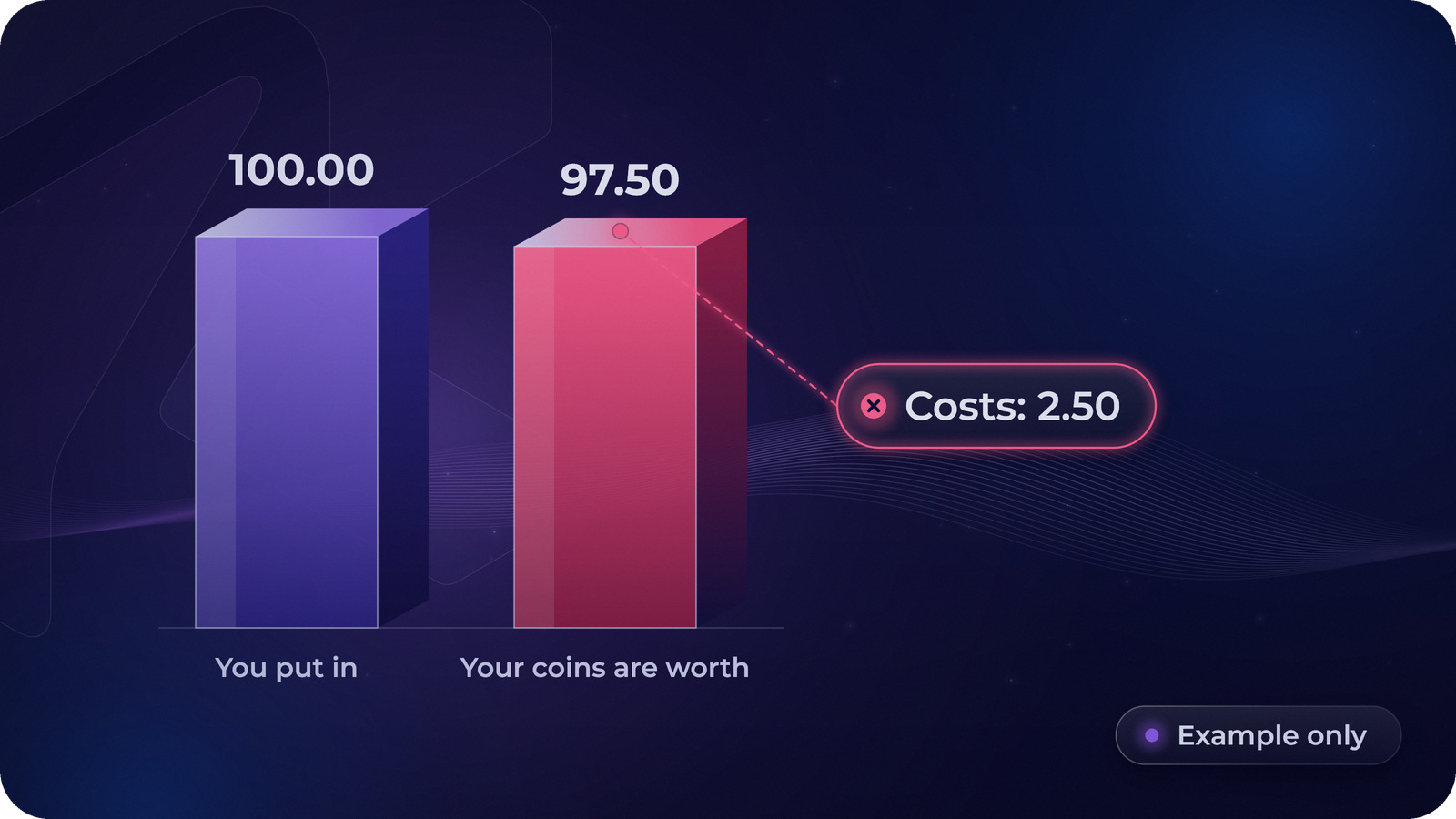
Mia puts $100 (or €100) into a coin. A minute later she checks her balance: about $97.50. The coin's price hasn't moved. Where did $2.50 go?
Into costs. Every time you buy, sell or move crypto, someone does work: the platform matches your order, a blockchain records a transfer, a bank moves your money. Each of them can charge for it.
None of this is hidden on purpose, but it is easy to miss. Most people look at the coin's price and forget the rest. In this course you'll learn to see the full cost of a trade, add it up and spot the costs that grow quietly when you trade often.
The numbers in this course are made up to explain the mechanics. Real fees differ between providers and change over time.
Five costs to know
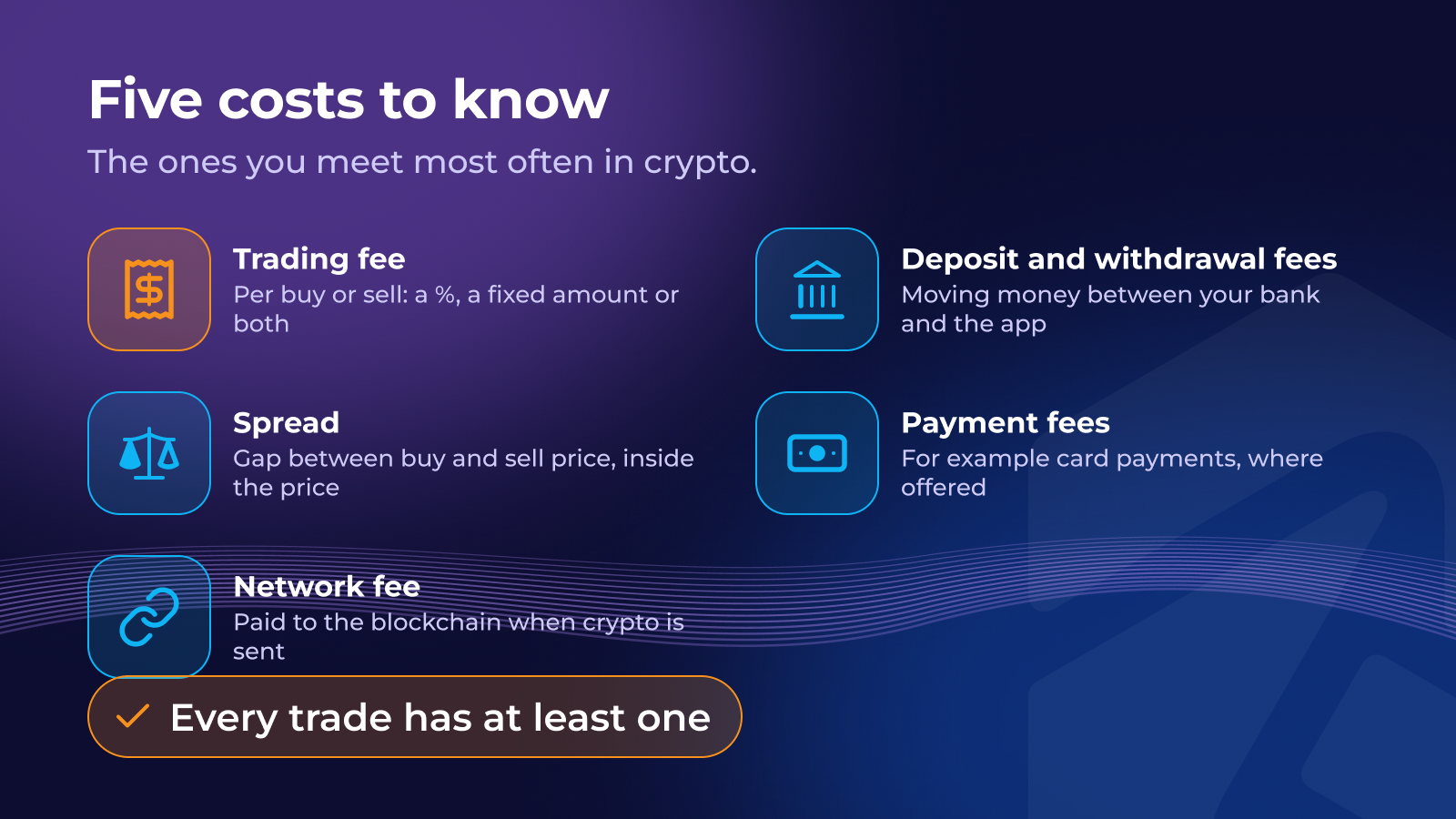
These are the costs you'll meet most often in crypto:
- Trading fee. A charge for each buy or sell, as a percentage, a fixed amount or both. Usually shown as its own line.
- Spread. The difference between the price you can buy at and the price you can sell at. It's usually inside the price, not on a separate line.
- Network fee. Paid to the blockchain's validators or miners when crypto is sent from one address to another, for example to your own wallet.
- Deposit and withdrawal fees. For moving money between your bank and the app.
- Payment fees. For example when paying by card, where that is offered.
Not every trade has all five. But every trade has at least one.
Quick check
Leo sends some crypto from an app to his own wallet. Which cost belongs to this step?
Where to find the costs
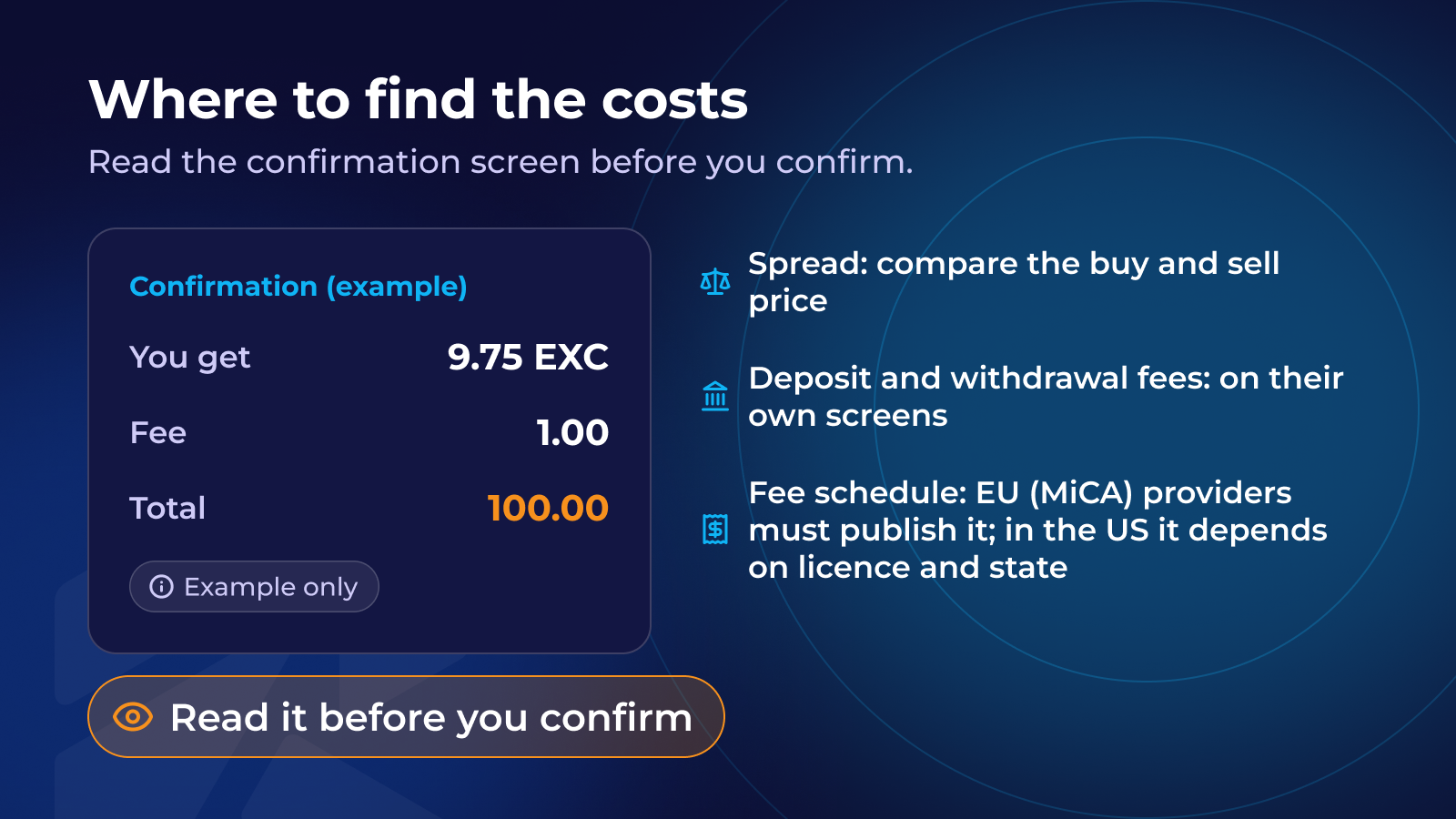
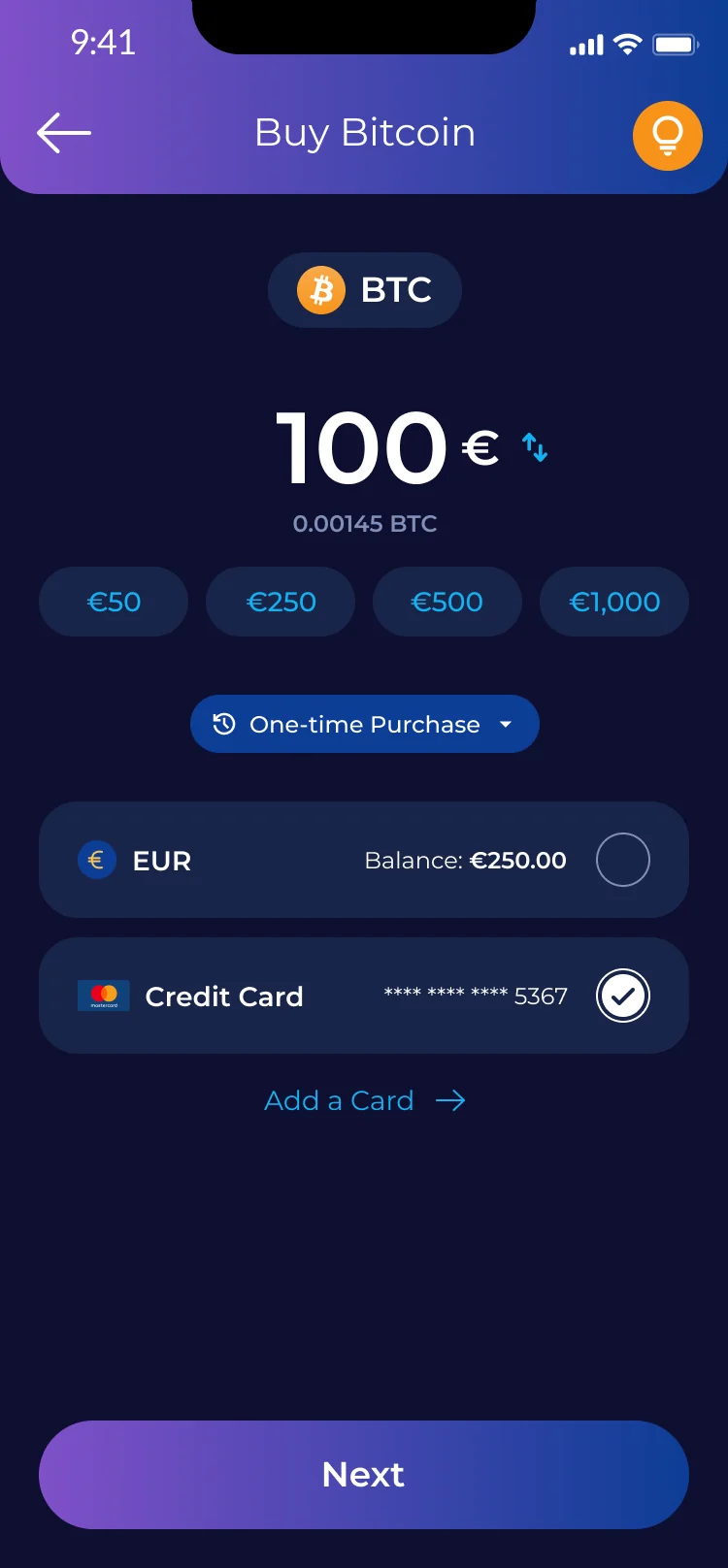
A good habit: never confirm a trade before you've read the confirmation screen. It should show the amount of crypto you'll get, the fee and the total you'll pay.
The spread is harder to see because it's built into the price. One way to spot it: look at the buy price and the sell price of the same coin at the same moment. The gap between them is the spread.
Fees for deposits and withdrawals are usually shown on their own screens, before you confirm.
Providers also publish a fee schedule. In the EU, the MiCA regulation requires crypto-asset service providers to make their pricing and fee policy public; in the US, disclosure rules depend on the provider’s licence and state. Reading it once tells you which costs exist, even if the exact amount depends on the trade.
Quick check
Which of these can be part of the cost of a crypto trade? Select all that apply.
Select all that apply
Quick check
Ana compares two apps. App A says “zero fees”. App B charges a 1% fee. What should she check before deciding which is cheaper?
Recap: look at the total
Three things to remember:
- The price of a coin is only part of what you pay.
- Costs come as fees (shown as a line) and spreads (inside the price), plus network and transfer fees.
- The confirmation screen is where you check them, every time, before you confirm.
See it for yourself: before any trade, a provider's confirmation screen shows the fee and the total. Looking costs nothing.
Crypto prices can rise and fall sharply, and you could lose some or all of the money you put in. Crypto is not covered by deposit protection. This lesson is education, not financial advice.
Next: the spread, explained with a worked example.
Lesson complete!
0 / 3
That's the first chapter. Continue this course — and unlock the rest — in the Rumos app.